Why Pilates for Abs Delivers Results Beyond Traditional Crunches
Pilates for abs is one of the most effective ways to build a strong, functional core that goes far deeper than surface-level definition. Unlike traditional crunches that only target the superficial “six-pack” muscles, Pilates engages your entire powerhouse—including deep stabilizers like the transverse abdominis, pelvic floor, and multifidus that act like a natural corset for your spine.
Quick Answer: The 6 Best Pilates Exercises for Abs
- The Pilates Hundred – Builds core endurance with rhythmic breathing and sustained engagement
- The Roll Up – Strengthens abs through controlled spinal articulation
- Single Leg Stretch – Targets lower abs while maintaining pelvic stability
- Double Leg Stretch – Challenges the entire powerhouse with full-body extension
- Criss Cross – Sculpts obliques through controlled trunk rotation
- The Teaser – Develops advanced core control and balance
If you’re tired of doing endless crunches without seeing real results, you’re not alone. Research shows that Pilates offers something traditional ab exercises don’t: small, precise movements combined with controlled breathing that activate your core muscles more effectively than big, sweeping motions.
A 2023 study found that core training through Pilates significantly improves balance and core endurance in athletes. Another 12-week program showed improvements in both core strength and decreased body fat in middle-aged women. The secret? Pilates doesn’t just work your abs in isolation—it trains your entire core system to function as the powerhouse it was designed to be.
As certified personal trainers have noted, the most defined and functional cores often come from regular barre and Pilates practice, not from traditional ab-focused workouts. That’s because Pilates challenges your deep stabilizing muscles with every single move, whether you’re on a mat or working on a reformer.
We’ll break down six essential Pilates exercises that will transform your core strength, improve your posture, and help you move more efficiently in daily life—all without putting unnecessary strain on your neck or lower back.
The Science of Pilates for Abs
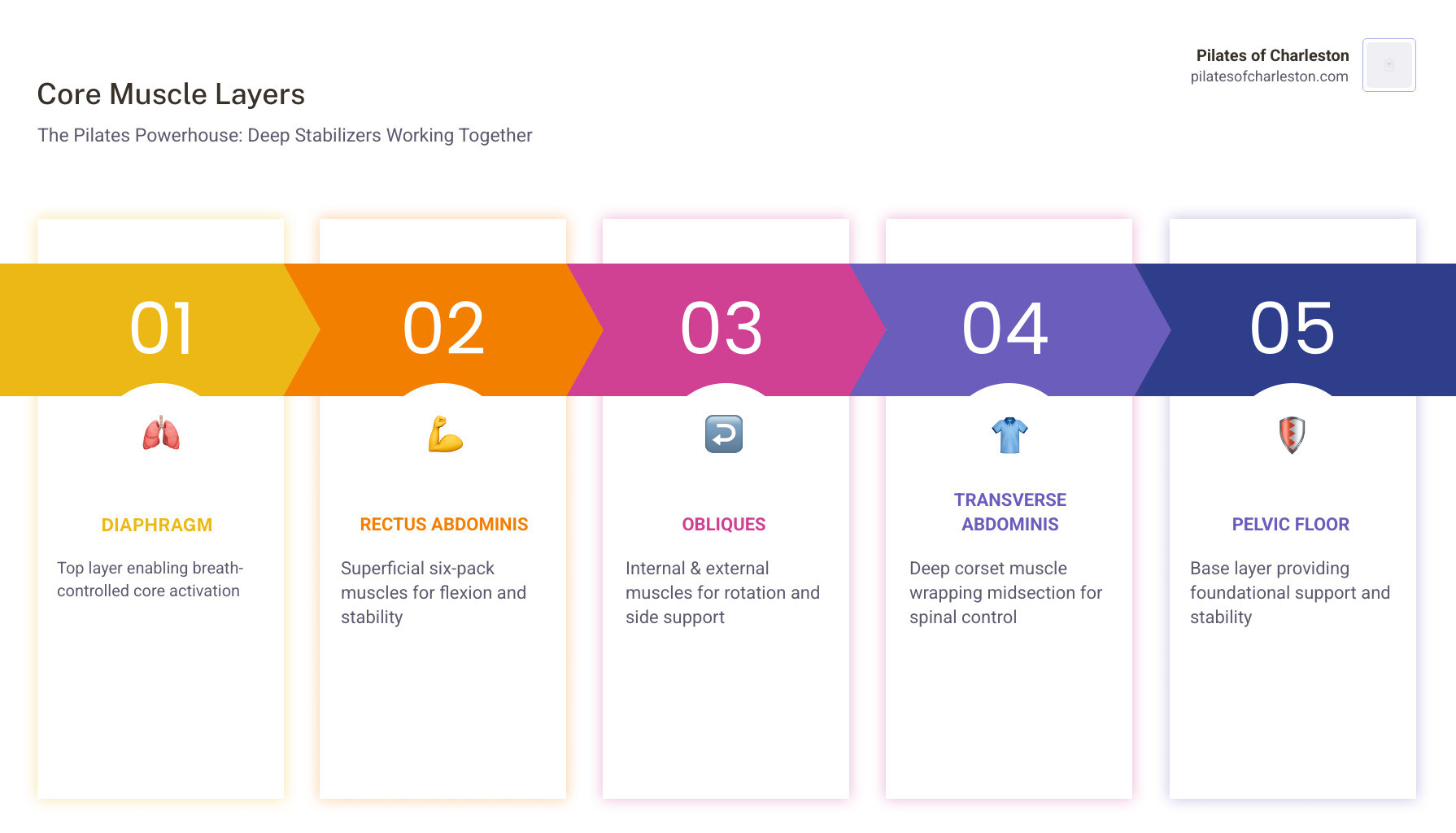
To understand why pilates for abs is so effective, we have to look at the anatomy of the “Powerhouse.” In the Pilates world, the core isn’t just the front of your stomach; it’s a three-dimensional box that includes the transverse abdominis (TVA), rectus abdominis, internal and external obliques, the pelvic floor, and even the diaphragm.
The TVA is often called the “corset muscle” because it wraps around your midsection to provide stability and support for your spine. Most traditional gym exercises miss this muscle entirely. Pilates, however, focuses on inner-to-outer activation. By controlling your spinal position, you learn to engage these deep layers before the “show” muscles (the rectus abdominis) take over. This creates a flatter, tighter midsection and a safer spine.
Scientific research backs this up. A study on Pilates and body composition suggests that consistent practice influences muscle strength and fat distribution. Furthermore, a 2023 study on core training and athletic performance highlighted that core endurance and balance—two hallmarks of Pilates—are critical for preventing injury and boosting overall physical capacity. When we train the core as a functional unit rather than isolating a single muscle, we reap more info on the benefits of Pilates such as improved gait speed, better posture, and reduced joint pain.
Six Essential Pilates Exercises for a Stronger Core

Before we dive into the moves, remember the “Pilates Principles”: concentration, control, centering, precision, breath, and flow. We don’t rush through these reps. We move with integrity. Whether you are practicing on a mat at home or using our Balanced Body Allegro 2 Reformers, the goal is to keep your powerhouse engaged and your movements fluid.
Comparison: Mat vs. Reformer Ab Engagement
| Feature | Mat Pilates Abs | Reformer Pilates Abs (Allegro 2) |
|---|---|---|
| Resistance | Gravity & bodyweight only | Adjustable spring tension |
| Support | Floor provides a stable base | Moving carriage challenges stability |
| Range of Motion | Limited by the floor | Increased via pulley and strap systems |
| Muscle Recruitment | High focus on stabilization | Deep eccentric & concentric control |
1. The Pilates Hundred
The Hundred is the classic Pilates warm-up. It gets the blood pumping and coordinates your breath with core engagement.
- How to do it: Lie on your back with your legs in a tabletop position (knees bent at 90 degrees). Curl your head, neck, and shoulders off the mat. Extend your arms long by your sides, hovering them a few inches off the floor.
- The Action: Pump your arms up and down vigorously. Inhale for 5 counts and exhale for 5 counts.
- The Goal: Reach the “magic number” of 100 pumps. Focus on keeping your lower back pressed into the mat and your navel drawing deep toward your spine.
2. The Pilates Roll Up
The Roll Up is often cited as being six times more effective than a standard crunch. It requires incredible spinal articulation—the ability to move your spine bone by bone.
- How to do it: Lie flat with arms extended overhead. Inhale as you lift your arms toward the ceiling.
- The Action: Exhale as you tuck your chin and peel your spine off the mat, one vertebra at a time. Reach for your toes while scooping your belly in. Inhale at the top, and exhale as you slowly roll back down, resisting gravity.
- Pro Tip: Imagine your spine is a strand of pearls, and you are laying them down one by one. For more help with alignment, check out our technique tips for ribs and abs.
3. Single Leg Stretch
This move is all about coordination and pelvic stability. Your abs have to work hard to keep your torso still while your legs are in motion.
- How to do it: Curl your head and shoulders up. Draw your right knee to your chest, placing your left hand on the knee and your right hand on the ankle. Extend your left leg out to a 45-degree angle.
- The Action: Switch legs with a sharp exhale, pulling the left knee in and extending the right leg.
- Focus: Keep your “powerhouse box” (the area between your shoulders and hips) perfectly still. Don’t let your hips rock!
4. Double Leg Stretch
If Single Leg Stretch is the appetizer, this is the main course. It challenges your core endurance by moving all four limbs away from your center.
- How to do it: Start in a tight ball, knees to chest, head and shoulders curled up.
- The Action: Inhale as you reach your arms back by your ears and extend your legs to 45 degrees. Exhale as you circle your arms around and hug your knees back in.
- The Secret: Keep your lower back glued to the floor. If it starts to arch, reach your legs higher toward the ceiling. This is a foundational guide to getting stronger abs.
5. Criss Cross
This is the ultimate “waist whittler.” Unlike the frantic “bicycle crunch” seen in many gyms, the Pilates Criss Cross is slow and controlled.
- How to do it: Hands behind your head, elbows wide, knees in tabletop.
- The Action: Twist your torso so your right shoulder moves toward your left knee as the right leg extends. Switch sides.
- Key Point: Don’t just pull on your neck. Think about lifting your shoulder blade off the mat to reach for the opposite knee. This ensures your obliques are doing the work, not your arms.
6. The Teaser
The Teaser is the “gold standard” of Pilates exercises. it combines strength, balance, and flexibility into one beautiful, albeit challenging, V-sit.
- How to do it: Lie on your back with legs extended.
- The Action: Simultaneously lift your torso and legs into a V-shape. Reach your arms parallel to your legs.
- The Challenge: Hold the position for 3-5 breaths, keeping your chest open and your spine long. Slowly roll back down with control. It’s the ultimate test of advanced core control.
Maximizing Your Pilates for Abs Results
While pilates for abs will undoubtedly make your core stronger, achieving a visible “six-pack” requires a holistic approach. You can have the strongest abdominal muscles in the world, but they won’t be visible if they are covered by a higher body fat percentage.
To see the best results, we recommend the 3-2-8 method: three days of strength training, two days of Pilates or barre, and a daily goal of 8,000 steps. This combination builds muscle, improves flexibility, and keeps your metabolism revved up.
We also believe in looking at movement through an evolutionary lens. The human structure evolved for activities like standing, walking, running, and throwing. Research on evolutionary movement shows that our bodies function best when we train in ways that mirror these natural patterns. Pilates helps bridge the gap between “gym strength” and “functional life strength” by ensuring your core is stable enough to support these complex movements.
Beginner-Friendly Pilates for Abs Modifications
If you’re just starting out, don’t be intimidated! You can still get an amazing workout by making these small adjustments:
- Bent Knees: Keep your knees bent in a tabletop position instead of extending them straight.
- Head Down: If your neck feels strained, keep your head on the mat during leg movements.
- Limited Range: Only lower your legs as far as you can while keeping your back flat.
- Stability Support: Use a chair or the floor for balance during standing Pilates moves.
Advanced Pilates for Abs Progressions
Ready to level up? At Pilates of Charleston, we use various props to increase the burn:
- Magic Circle: Squeezing the circle between your ankles or hands during the Hundred or Teaser adds intense inner-thigh and arm engagement.
- Slower Tempo: The slower you go, the more muscle fibers you recruit. Try a 5-second count for your Roll Ups.
- Resistance Bands: Adding bands to your Double Leg Stretch forces your core to fight against extra tension.
Frequently Asked Questions about Pilates for Abs
Can Pilates alone give you a visible six-pack?
Pilates is world-class for building muscle hypertrophy and core development. However, visible abs are largely a result of body fat percentage and nutrition. Pilates will give you the underlying structure and a “tighter” waistline by strengthening the transverse abdominis (the corset muscle), but a balanced diet is key to revealing that definition.
How often should I do Pilates ab workouts?
Consistency is key. We recommend practicing pilates for abs 2-3 times per week. This allows for adequate recovery time while still providing enough stimulus to see changes in strength and posture within about three weeks. By 12 weeks, most clients notice significant changes in their body composition and core endurance.
Is Pilates safe for people with lower back pain?
Yes! In fact, it’s often recommended. Pilates focuses on activating the multifidus and other deep stabilizers that provide relief from lower back pain. By learning to support your spine with your powerhouse, you take the pressure off your joints and discs. If you’re unsure what is Pilates exactly or how it helps, it’s essentially a system of “corrective exercise” that fixes the imbalances caused by sitting at desks all day.
Conclusion
At Pilates of Charleston, we are dedicated to helping you achieve a core that is as functional as it is aesthetic. Our boutique studio in Mount Pleasant, SC, offers a premier experience with professional instruction on Balanced Body Allegro 2 Reformers. Whether you are a total beginner or an advanced practitioner, our classes are designed to challenge your limits and help you discover the true power of your “Powerhouse.”
Ready to transform your core? View our services and rates and join us for a session that will leave your abs on fire and your body feeling rejuvenated. We can’t wait to see you in the studio!