If you have typed “mat Pilates classes Charleston” into your phone and gotten back a list of studios instead of an answer, here it is. Mat Pilates and reformer Pilates teach the same method; what changes is where the resistance comes from. On a mat, your own body weight is the load. On a reformer, a sliding carriage pulled by springs is — and a spring can make a movement easier just as readily as it makes it harder. That one difference is why many beginners do better starting on the machine rather than on the floor.
What a mat Pilates class actually is
A mat class is Pilates on the floor, usually with nothing but a padded mat and sometimes a small prop — a ring, a light ball, a band. You move through a controlled sequence with your breath setting the pace and your deep abdominal muscles doing the stabilizing: the hundred, roll-ups, leg circles, the side-lying series.
This is the original form. Joseph Pilates built the mat repertoire first and designed the apparatus afterward, partly for people who could not yet hold the shapes on the floor. That order tells you something: mat work is the version with no help in it. Nothing supports your spine and nothing tells you when your form has quietly gone — an instructor does, which is why the size of a mat class matters more than people expect. To try the movement vocabulary before you spend anything, a core routine you can do without leaving your mat is a fair first test.
What changes when you add a reformer
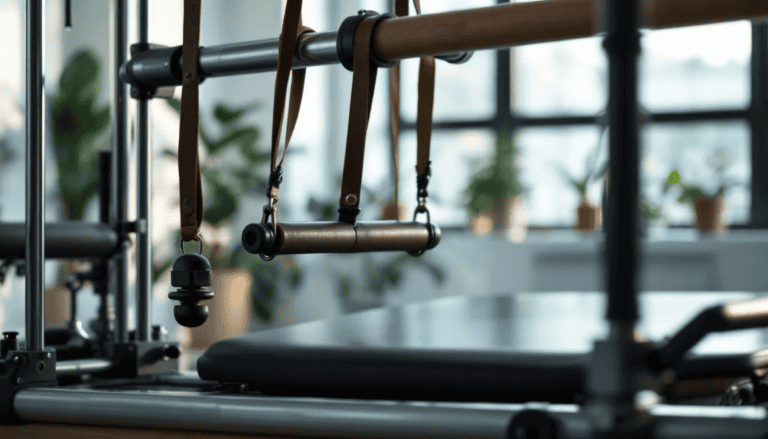
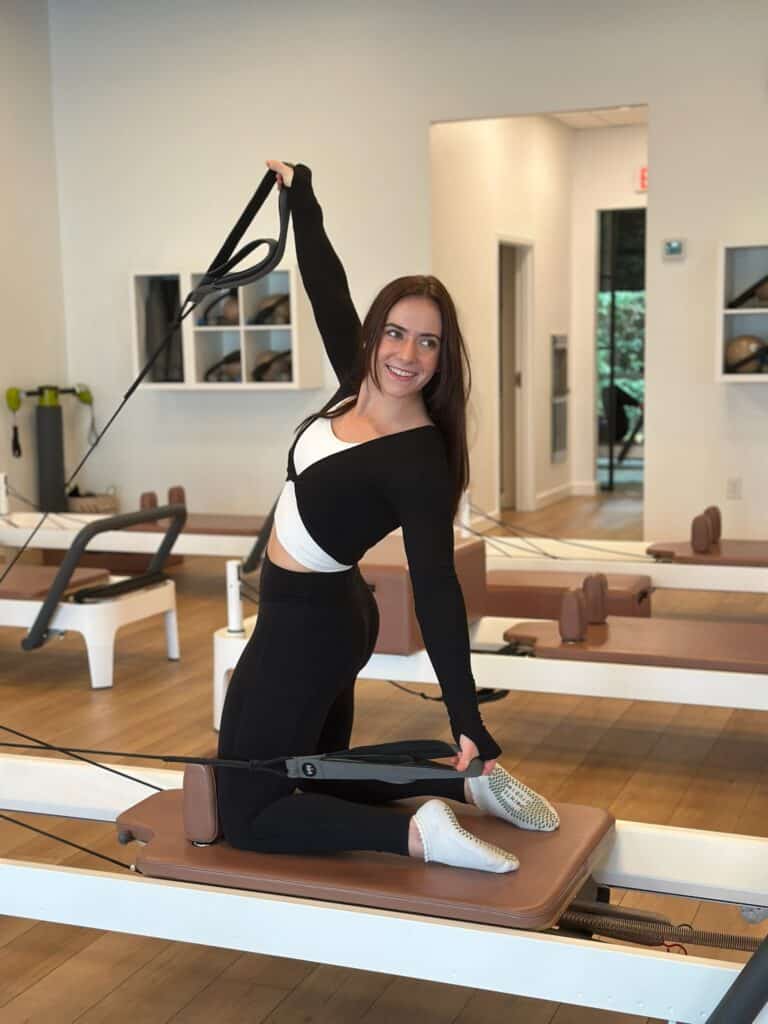
If you have never seen one, a reformer can look a bit like a medieval contraption at first glance: a low frame with a padded carriage that slides on rails, a footbar at one end, straps at the other, and springs underneath that set the resistance. You lie, sit, kneel or stand on it, and the carriage moves when you move.
Three things change the moment you get on one. The springs can assist as well as resist, so a movement that is out of reach on the floor becomes possible with help, and you build toward the unassisted version instead of faking it. The carriage gives instant feedback: lose your center and it jerks, so you feel the error before anyone names it. And the range of work opens up, because you have springs, straps and a footbar to push and pull against.
The trade-off is access. A reformer costs more to buy and to house, so reformer classes are smaller and priced accordingly. Mat classes scale; reformer classes do not. For what else lives in a well-equipped studio — the tower, the chair, the barrel — see the four types of Pilates equipment and who each one suits.
Which one should you book first?
Book the format that matches the reason you are coming.
Start on the reformer if you are new or rebuilding
The springs are the argument. They let you work at a load that suits you today instead of the load the floor happens to impose, and the carriage makes your mistakes legible. Beginners tend to leave a first reformer class knowing what their deep core was supposed to be doing — which rarely happens after a first mat class.
Start on the mat if you already move well
Runners, lifters, swimmers and longtime yoga students usually have enough body awareness to get value out of mat work immediately, and mat classes are easier to take often. If your week already has strength training in it and you want Pilates for control and mobility, the floor is a reasonable front door.
Book a private session first if you are managing something
A current injury, a recent surgery, a pregnancy, or a back that flares without warning is not a reason to skip Pilates. It is a reason not to meet it for the first time in a group room. Tell your instructor before any class, and when it is significant, start with a private reformer session so the springs and the modifications are set around you.
Mat Pilates classes in Charleston: what to ask before you book
Search results for this phrase are mostly booking apps and directories, so a few questions sort the real options fast.
- What is the cap? A mat class can run twenty deep and still be a decent workout, but you will not be corrected in it. Ask for the maximum, not the average.
- Is it Pilates, or Pilates-adjacent? Several Charleston studios run heated mat classes, megaformer workouts or yoga-sculpt hybrids. Those are good workouts with different aims. If you want the classical method, ask what the instructor trained in.
- Who is teaching, and what are you buying? Certification programs vary widely in length and depth, and passes, memberships and contracts behave very differently the month your schedule falls apart.
Pilates of Charleston answers those plainly. It is a reformer studio in Mount Pleasant with eight reformers and a cap of eight people, published alongside the rates rather than discovered at the door. It has been open under the same owner since 2011; the owner has taught Pilates for more than twenty years and films for Dynamic Pilates TV. Charleston City Paper readers voted it Best Pilates Studio in 2023 and 2024, and it is nominated again for 2026. Classes are bought as passes with a monthly membership, with no long-term contract.
The studio is at 778 S. Shelmore Blvd in Mount Pleasant, next to Langdon’s and Wood & Grain, with Second State coffee next door if you arrive early; the Mount Pleasant location page has the map. It draws from Mount Pleasant, Daniel Island, Isle of Palms, Sullivan’s Island and downtown Charleston.
What a first class is actually like
Expect to arrive a few minutes early, leave your shoes at the door and wear grip socks, which most Pilates studios ask for. The instructor will ask whether anything is bothering you; answer honestly, including the thing you assume is too small to mention. You will be shown your reformer, told which springs to set, and taught each movement before you do it at pace. Nobody expects you to know the vocabulary — the room is meant to be inviting, not intimidating.
One practical thing before you book: the cancellation policy is firm, with no exceptions, and that includes weather and traffic. Treat the booking the way you would a doctor’s appointment. Class etiquette for first-timers covers the rest of the unwritten rules, and the newbie guide to beginner Pilates in Mount Pleasant walks through a first visit end to end.
So which do you book this week?
If you are starting from scratch, book the reformer. The springs give you a version of every movement you can do well today, and a room of eight means the correction is meant for you. If you already train hard and want frequency, mat work will serve you, and you can add reformer sessions when you want precision. If you are still choosing between movement styles, read the difference between yoga and Pilates first; the two get confused constantly, and they change different things.
Then book one and go. The first class is the only awkward one, and being known by name is the whole point of keeping the room at eight.
Frequently asked questions
Is mat Pilates actually effective?
Yes, when the class is taught well and you go consistently. Your own body weight is real resistance, and the mat repertoire gets demanding as soon as you stop cheating the shapes. The catch is that nothing on the floor corrects you, so results lean heavily on the instructor seeing you and on your own body awareness. In a crowded room, both get thin.
Is Pilates good for back pain?
Plenty of people come to Pilates after back trouble, and the method’s focus on spinal control and deep abdominal support is part of why. Back pain has many different causes, though, and this is not medical advice: ask your doctor or physical therapist whether Pilates suits your situation. Then tell your instructor what is going on before class. If your back flares unpredictably, start with a private session rather than a group one.
What is the 80/20 rule in Pilates?
It is not one of Joseph Pilates’ original principles, and you will not find it in a certification manual. Most people use it as shorthand for leaving something in reserve: working at roughly four-fifths of your maximum so your form holds and the right muscles keep doing the work. Others use it to mean that most of your progress comes from a small number of fundamentals done well. Both readings point the same direction, which is control over effort.
Do I need to be flexible or strong before my first class?
No. Flexibility is an outcome, not an entry requirement, and the reformer springs exist partly so that someone who cannot yet reach a position can still work toward it. Say it is your first class when you book, and tell the instructor what your body does and does not do easily. A cap of eight people exists for exactly this reason.
How often should I take class to notice a change?
Most people feel the difference before anyone sees it, usually in how they sit, stand and get out of bed. Two or three sessions a week is a common rhythm for building strength, and once a week tends to hold what you have built. Buying passes rather than signing a contract lets you test a rhythm before you commit to one.