Search “types of Pilates” and the lists you get back mix two different things: the apparatus you work on and the teaching style behind it. There are four main pieces of Pilates equipment — the mat, the reformer, the tower and the chair — and three broad styles that can be taught on any of them. The apparatus decides what your body feels. The style decides how the hour is run. Here is what each one does, and who it suits.
Two questions hide inside “types of Pilates”
Most articles on this subject hand you one list: classical, contemporary, clinical, mat, reformer. That list quietly mixes two categories. Mat and reformer are equipment. Classical, contemporary and clinical are styles — teaching lineages that can be applied to any apparatus. A classical reformer class and a contemporary reformer class use the same machine and feel noticeably different.
So when you ask which type of Pilates to book, you are really asking two questions.
- Which apparatus? Mat, reformer, tower or chair. This sets how much support you get, how the resistance is applied, and what the hour physically feels like.
- Which style? Classical, contemporary or clinically oriented. This sets the order of the exercises, how much an instructor modifies them, and how the room is taught.
On day one, the apparatus question matters more. Almost nobody books a first class by lineage; they book a mat class or a reformer class and find out the rest when they get there. All four pieces of equipment came out of the same body of work, which traces back to Joseph Pilates and the system he called Contrology.
Mat Pilates: your own body weight, and nowhere to hide
Mat Pilates is the original work. Joseph Pilates published a sequence of floor exercises in the 1940s, and it still forms the spine of the method: controlled movements performed lying, sitting and kneeling on a mat, powered by nothing but your own body weight and your breath.
A mat class may add small props — a magic circle (a padded metal ring you squeeze between your hands or knees), a light ball, a resistance band, a weighted bar. None of them change the basic bargain: nothing assists you. If your hamstrings are tight, the roll-up is hard, and the mat will not hand you a spring to make it easier.
That is why plenty of people find mat work harder than it looks, and why experienced students keep going back to it. It is also the most portable version of the method. A mat, a strip of floor and twenty minutes is a complete practice.
Mat Pilates suits you if
- You already know the exercises and want to practice between studio sessions.
- You travel and want something you can do in a hotel room.
- You want the lowest-cost way into the method.
- You like work that gives you no help and no excuses.
Our guide to building core strength without leaving your mat is a reasonable way to try the work before you book anything.
Reformer Pilates: springs, straps and a carriage that moves
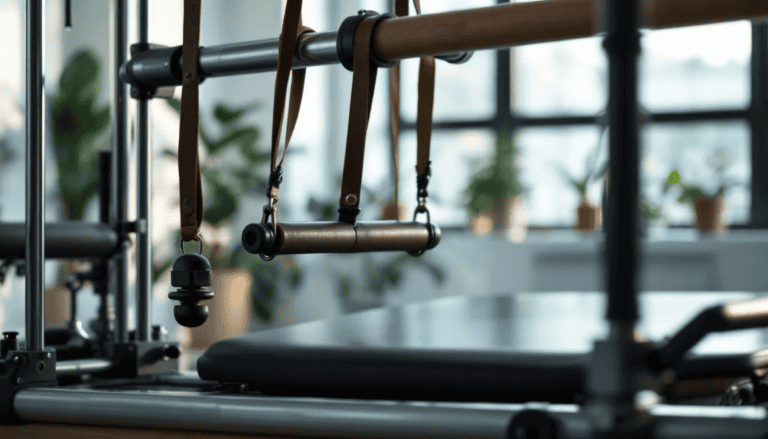
The reformer is the machine most people picture when they picture a Pilates studio, and we will be honest: it can look a bit like a medieval contraption at first glance. It is not complicated. A reformer is a low frame with a padded platform, called the carriage, that slides along rails. The carriage is attached to a bank of springs. One end has an adjustable footbar; the other has two long straps with handles. You can lie on it, sit on it, kneel on it, stand on it, or work half on and half off.
What the springs actually do
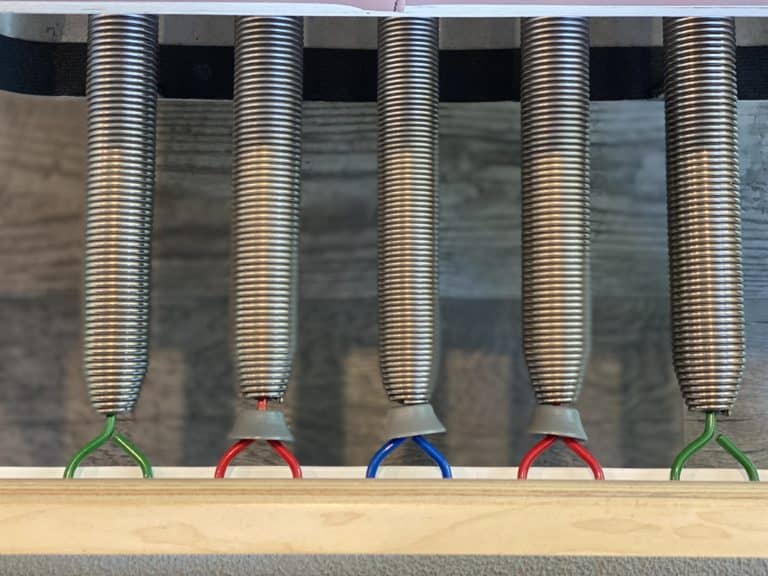
The springs are the whole point, and they are the thing no video explains well. Clip on a different combination and the same exercise changes character.
- Heavier springs give you more resistance when you push the carriage away, as in footwork, and more support when the carriage is carrying your weight.
- Lighter springs take that support away. Stabilizing a carriage that wants to drift is far harder than moving one that is anchored.
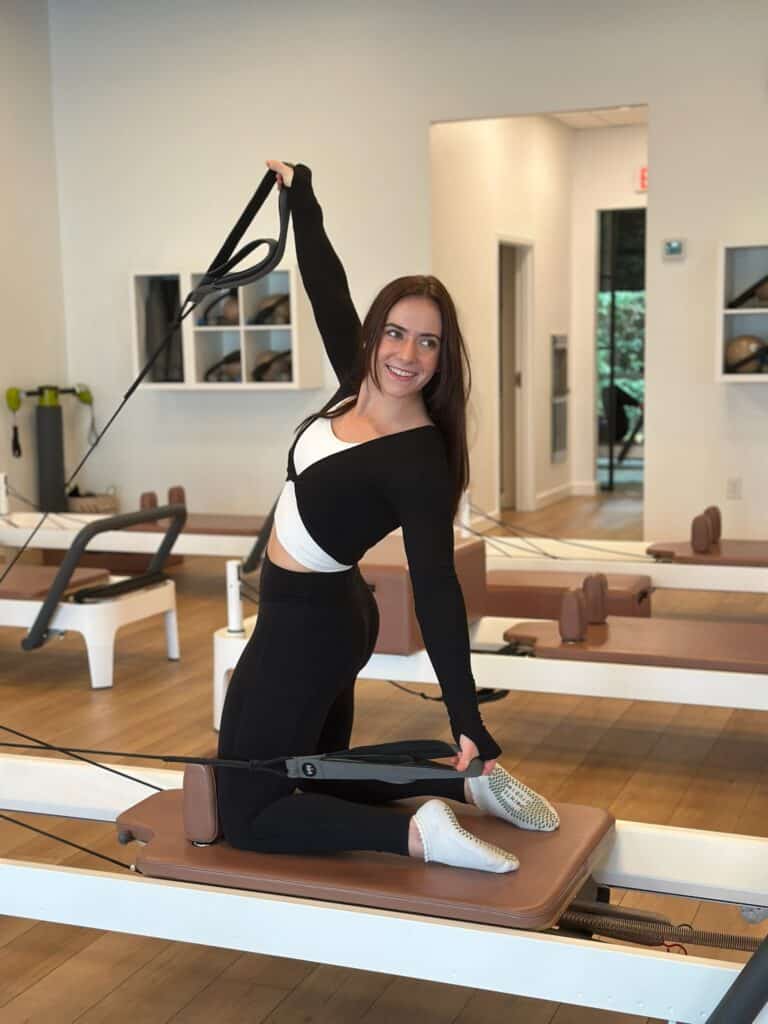
This is the part that surprises new students: heavier is not automatically harder. In a kneeling arm series, the lighter spring is the harder setting, because nothing is holding the carriage still for you. A good instructor changes your springs during class for exactly this reason.
Why first-timers often find the reformer easier than the mat
Because a spring can assist. An exercise that is out of reach on the floor can be within reach on the carriage with the right load. The headrest, the shoulder blocks and the footbar also give your body reference points, so you can feel when your alignment has slipped instead of guessing.
The catch is that none of this helps if the instructor cannot see you. Spring changes and hands-on corrections are why class size matters more than almost anything else on a studio’s schedule. If you are comparing studios, our piece on what to look for in a reformer studio covers the questions worth asking.
The tower and the Cadillac: vertical springs, more support
If the reformer works mostly horizontally, the tower works vertically. A tower is a frame of uprights fitted with springs at several heights, a push-through bar, and loops for the arms and legs. Many studios run it as a combination unit: a reformer with a tower built onto one end.
The full-size relative is the Cadillac, also called the trapeze table — a raised, padded table with a canopy frame above it carrying springs, straps, a trapeze bar and a push-through bar. It looks dramatic. It is mostly used for slow, exact work.
Tower and Cadillac sessions tend to be quieter than a reformer class: spinal articulation one vertebra at a time, shoulder mechanics, leg springs, hip work. The apparatus can take a lot of your body weight, which makes it useful when someone needs support, and just as useful when a strong student wants to isolate something small and get it right.
Because the setup takes time and the cueing is individual, tower and Cadillac work is usually taught privately or in very small groups. If a specific apparatus matters to you, ask the studio what is actually on the floor before you book. Equipment varies a lot between studios, even between two that both describe themselves as reformer studios.
The Wunda chair: small, portable, completely honest
The chair is the smallest of the four. Picture a padded box about the size of a nightstand with a spring-loaded pedal on one side — split into two independent pedals on many models — and a pair of handles that can be added above it. It was designed to be compact, and it is still the piece most likely to fit in a spare room at home.
It is also the least forgiving. There is almost no surface to lie down on, so the work happens seated, standing, kneeling or in a lunge, and the pedal gives you a very small, very specific target. Single-leg presses on the chair will tell you within two repetitions which side of your body has been doing more of the work.
That honesty is why dancers, athletes and long-time students like it. For a different reason, it also suits people who find getting down to the floor and back up again difficult, since so much chair work happens seated or standing.
Classical, contemporary and clinical: the styles layered on top
Once you have picked an apparatus, the style tells you how the hour will be taught.
Classical
Classical Pilates teaches the original repertoire in the order Joseph Pilates set, on the apparatus he designed. The order is treated as part of the method rather than a suggestion, the transitions between exercises are part of the work, and the class tends to move at a steady, unbroken pace. If you like knowing exactly what is coming, you will like it.
Contemporary
Contemporary Pilates keeps the principles — centering, control, precision, breath, flow — and gives itself room to reorder exercises, modify them for different bodies, and borrow from later research on strength and rehabilitation. Props show up more often. Most group reformer classes you will find in the United States sit somewhere on the contemporary side.
Clinically oriented Pilates
“Clinical Pilates” usually describes Pilates-based exercise delivered inside a rehabilitation setting, often by a physical therapist following a plan for a specific diagnosis. A group studio class is not that, and it is not a replacement for it. If you are working through an injury, a diagnosed condition or a recent surgery, speak with your physician or physical therapist first, and tell the studio before you book rather than when you are already on the carriage.
How to read an instructor’s training
Pilates instruction is not a licensed profession in the United States, so the training behind the person running your class varies more than most people assume — from a weekend workshop on one piece of equipment to a comprehensive program of several hundred hours with supervised teaching. The Pilates Method Alliance, the method’s longest-running professional association, offers a certification exam that is not tied to any single training school.
So ask. Any studio worth your money will answer plainly. At Pilates of Charleston, the owner has taught Pilates for more than twenty years and films for Dynamic Pilates TV, and you can read where each of our instructors trained before you book.
Choosing your first class: a short decision guide
You have never done Pilates before
Start on the reformer, in a class with a small cap, or book a private session first. The springs give you support the floor cannot, and a capped class means the instructor can actually adjust you. Our newbie guide to beginner Pilates in Mount Pleasant covers what to wear and what the first hour involves. If the part you are dreading is looking lost in a room full of regulars, how to start Pilates without looking ridiculous was written for exactly that.
You are managing an injury or a flare-up
Book a private first. Tell the instructor what is going on when you book, not once the class has started — they need to know before they set your springs. A few private reformer sessions give an instructor time to learn your body and hand you into a group class with a plan.
You are pregnant or postpartum
Clear it with your provider, then tell the studio where you are. The work changes as pregnancy progresses, and so do the positions you can comfortably hold on a carriage. We cover what prenatal reformer work changes trimester by trimester separately.
You are coming back after a long gap
The reformer and the chair are both friendlier here than the floor. Getting down to a mat and back up again repeatedly is its own obstacle, and both pieces let you work seated, standing, or lying on a surface that is already at hip height. A private session first is worth the money.
You want strength and visible definition
Reformer work, with mat work in between. Springs give you a load you can progress; the mat keeps you honest about what your body can do without help. If you are weighing the two, mat or reformer for your first class compares them directly.
You want to keep practicing between classes
Mat, at home, in short sessions. Twenty minutes three times a week does more than one heroic hour. Our on-demand Pilates videos exist for the weeks you cannot get to the studio.
You are still deciding between Pilates and yoga
They are not competing for the same job. We break down what yoga and Pilates each change in a separate piece.
What these types of Pilates look like in Mount Pleasant
Pilates of Charleston is a boutique reformer studio in Mount Pleasant. There are eight reformers in the room and a hard cap of eight people in a class, and that number is published next to the rates rather than buried. Eight is not a marketing figure; it is the number at which an instructor can change your springs, correct your shoulder position and still run the room. Our piece on how a capped group class actually runs goes through a 45-minute class in detail.
The studio has been open in Mount Pleasant since 2011 under the same owner. Classes are bought as a $40 drop-in or a 4- or 8-class pack, with no membership, contract or auto-renew. Charleston City Paper readers voted it the Best Pilates Studio in 2023 and again in 2024, and it is nominated again for 2026; the studio’s Google Business Profile carries 46 five-star reviews.
The studio is at 778 S. Shelmore Blvd in Mount Pleasant, next to Langdon’s and Wood & Grain, with Second State coffee next door — the usual place to wait if you arrive early. Students come from across Mount Pleasant, Daniel Island, Isle of Palms, Sullivan’s Island and downtown Charleston. Group bookings, including bachelorette parties, run on the same eight reformers.
Booking your first class
Pick the apparatus first. If you have never done this, that means a reformer class with a small cap, or a private session. The style question can wait until you have been a few times.
When you book, tell us about injuries, surgeries or a pregnancy. Anything significant and we will steer you toward a private session before a group class, which is a better start than an hour spent quietly modifying every exercise on your own. Wear something fitted enough that an instructor can see your alignment, and arrive a few minutes early. Our cancellation policy is firm, with no exceptions for weather or traffic, so put the class in your calendar like an appointment.
The room holds a lot of equipment, and it is inviting rather than intimidating. Everyone in it was new once. Contact the studio to ask which class to start with, or check the studio FAQ for what to bring and what to expect.
Frequently asked questions
How many types of Pilates are there?
There is no official count, which is why the lists online disagree. Counting equipment, there are four main pieces: the mat, the reformer, the tower (and its full-size relative, the Cadillac), and the chair. A fifth family, the barrels — the spine corrector and the ladder barrel — is often left off those lists but shows up in most fully equipped studios. Counting teaching styles instead, you get classical, contemporary and clinically oriented. Lists that claim five or six types are usually mixing the two counts together.
Which type of Pilates is most effective?
The one you will actually do twice a week. Effectiveness depends on your goal: the reformer gives you a load you can increase gradually plus the support to work safely, so it suits most people building strength; the mat suits people who want consistency without a studio. If you are rehabilitating a specific injury, Pilates-based work guided by a physical therapist will beat a general class. No single apparatus outperforms the others across the board.
Which form of Pilates is the hardest?
Mat Pilates is the hardest to do well when you are new, because nothing assists you and there is no spring to make an exercise reachable. The Wunda chair is the hardest on balance and single-side strength, since the pedal gives you a tiny target and immediately exposes which leg has been doing the extra work. The advanced classical reformer repertoire is the hardest by raw difficulty, but it comes after years rather than weeks.
What are the 5 most important Pilates exercises?
There is no official top five, and any teacher who gives you one is naming favorites. Most point to the opening of the mat sequence: the Hundred, the roll-up, single-leg circles, rolling like a ball, and the series of five. They are not there because they are the hardest. They teach breath, spinal articulation, control of the pelvis and the ability to keep your center steady while your limbs move, which is what every later exercise builds on.
What kind of Pilates is best for beginners?
A reformer class with a small cap, or a private session first. The springs can assist as well as resist, so an exercise that is out of reach on the floor is often achievable on the carriage, and the frame gives you reference points for your alignment. Class size matters more than teaching style at this stage: an instructor who can see eight people can adjust your springs; one running a room of thirty cannot.