To understand why pilates for abs and waistline is so effective, we have to look back at its creator, Joseph Pilates. He originally called his method “Contrology,” defined as the complete coordination of body, mind, and spirit. At the heart of Contrology is the “Powerhouse.”
While many people use the terms “abs” and “core” interchangeably, in our studio, we look at the Powerhouse as a comprehensive engine room. It isn’t just the six-pack muscles you see on a fitness magazine; it includes:
- Transverse Abdominis (TVA): This is your deepest abdominal layer. It acts like a natural corset, wrapping around your midsection to compress the abdomen and support the spine. When you “hollow” your belly in Pilates, you are firing up the TVA to cinch the waistline.
- Internal and External Obliques: These muscles sit on the sides of your torso. They are responsible for rotation and side-bending. Strengthening them is the key to carving out definition along the sides of your waist.
- Rectus Abdominis: The “six-pack” muscle that runs vertically. While Pilates doesn’t obsess over this muscle alone, it is integrated into every “curling” movement.
- Pelvic Floor and Multifidus: These deep stabilizers provide the foundation for your torso, ensuring that your movements are supported from the very base of your spine.
The effectiveness of this approach isn’t just anecdotal. Scientific research on core endurance and athletic performance published in Behavioral Sciences (2023) highlights that core training has a significant effect on general athletic markers, including balance and endurance. By focusing on these deep layers, Pilates provides a level of functional strength that traditional gym exercises often miss.
Pilates vs. Traditional Crunches
Many of our clients ask if they can just stick to crunches. While crunches have their place for building muscle size (hypertrophy), they often fail to address the deep stability required for a truly “flat” appearance and a healthy back.
| Feature | Pilates Core Training | Traditional Crunches |
|---|---|---|
| Primary Muscle | Transverse Abdominis & Obliques | Rectus Abdominis (Superficial) |
| Spinal Impact | Promotes spinal decompression & mobility | Can cause neck strain & spinal compression |
| Breathing | Lateral thoracic breathing (ribcage expansion) | Often involves breath-holding or shallow gasps |
| Movement Quality | Controlled, fluid, and precise | Often with momentum |
| Result | Cinching “corset” effect & better posture | Bulking of the front abdominal wall |
Essential Pilates Exercises for a Sculpted Core
When practicing pilates for abs and waistline, the “how” is just as important as the “what.” We focus on five main principles: Concentration, Control, Centering, Fluidity, and Precision. If you rush through the moves, you lose the deep muscle engagement that makes Pilates famous.

One of the most common mistakes we see is “doming” or “pooching” the abs. This happens when the superficial muscles take over because the deep TVA isn’t engaged. To avoid this, imagine pulling your navel toward your spine and “knitting” your ribs together as you exhale.
Classic Mat Pilates Moves
These are the “bread and butter” of any core routine. They require no equipment—just a mat and your own body weight.
- The Hundred: The ultimate warm-up. Lie on your back, legs in tabletop or extended to 45 degrees. Lift your head and shoulders, and pump your arms vigorously up and down. Inhale for 5 counts, exhale for 5 counts, until you reach 100. It pumps blood through the body and fires up the entire Powerhouse.
- The Roll-Up: More effective than six sit-ups! Slowly roll your spine off the mat one vertebrae at a time, reaching for your toes, then melt back down with total control.
- Single Leg Stretch: Hug one knee to your chest while the other leg hovers above the mat. Switch rapidly but with precision. This targets the lower abs and coordination.
- Double Leg Stretch: Reach your arms and legs away from each other, then circle the arms to hug the knees back in. This challenges your ability to keep your back glued to the mat.
- Criss-Cross: This is the Pilates version of a bicycle crunch, but slower. Focus on lifting your shoulder toward the opposite knee rather than just pulling your elbow. This is the gold standard for waistline sculpting via the obliques.
- Scissor Kicks: Keep your legs straight and switch them in a “snip-snap” motion. This builds incredible endurance in the lower abdominal wall.
- Teaser: The “V-sit” of Pilates. It requires balance, strength, and spinal flexibility. It is often considered the most challenging mat move.
- Pendulum: Lie on your back with legs in tabletop. Lower your knees to one side, using your obliques to pull them back to center. This is a fantastic “waist whittler.”
Beginner-Friendly Modifications
If you are just starting, don’t feel pressured to do the full versions. Integrity of form is better than a “perfect” looking move done incorrectly.
- Double-Leg Toe Taps: Instead of extending legs straight, keep them bent at 90 degrees. Lower your toes to tap the mat and use your lower abs to pull them back up.
- Glute Bridge: Squeeze your glutes and engage your core to lift your hips. This helps you understand how the back of the body supports the front.
- Single-Leg Toe Taps: A favorite for absolute beginners. It allows you to focus on stabilizing the pelvis one leg at a time.
- Neck Support: If your neck tires during the Hundred or Criss-Cross, keep your head down on the mat or place one hand behind your head for support.
Standing Pilates for Abs and Waistline Variations
Not every ab workout has to happen on the floor. Standing Pilates is excellent for functional movement, balance, and those who find mat work uncomfortable.

- Knee to Elbow Crunch: Stand tall and bring your knee up to meet the opposite elbow. Focus on the “crunch” happening in your midsection, not just moving your limbs.
- Standing Bicycle: Similar to the mat version, but performed standing. This challenges your balance and forces your deep stabilizers to fire.
- Lateral Lunge and Chop: Mimic a wood-chopping motion as you lunge. This uses your waist as a pivot point, creating a functional burn.
Pregnancy and Postpartum Note: Standing Pilates is often safer and more comfortable during pregnancy. It avoids the “supine” (lying on your back) position which can be restricted in later trimesters. For postpartum recovery, especially for those dealing with diastasis recti (abdominal separation), standing moves help re-engage the deep core without putting excessive outward pressure on the abdominal wall.
Maximizing Results: Diet, Frequency, and Reformer Training
We have to be honest: you can have the strongest abs in the world, but if they are covered by a layer of body fat, you won’t see that defined waistline. Spot reduction is a myth. You cannot choose where your body burns fat. To see your hard work, you need a holistic approach.
- The Role of Diet: Achieving visible abs requires a calorie deficit and a diet rich in whole foods to reduce overall body fat.
- The 3-2-8 Method: A popular and effective routine involves 3 days of strength training, 2 days of Pilates or barre, and hitting 8,000 steps daily. This combination ensures muscle building, core sculpting, and consistent calorie burn.
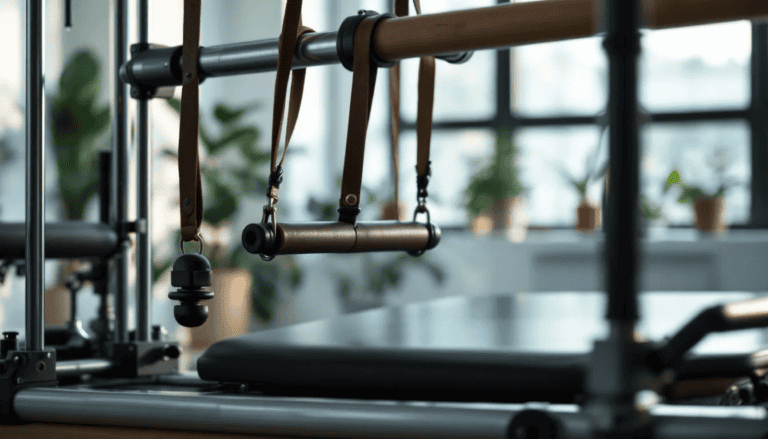
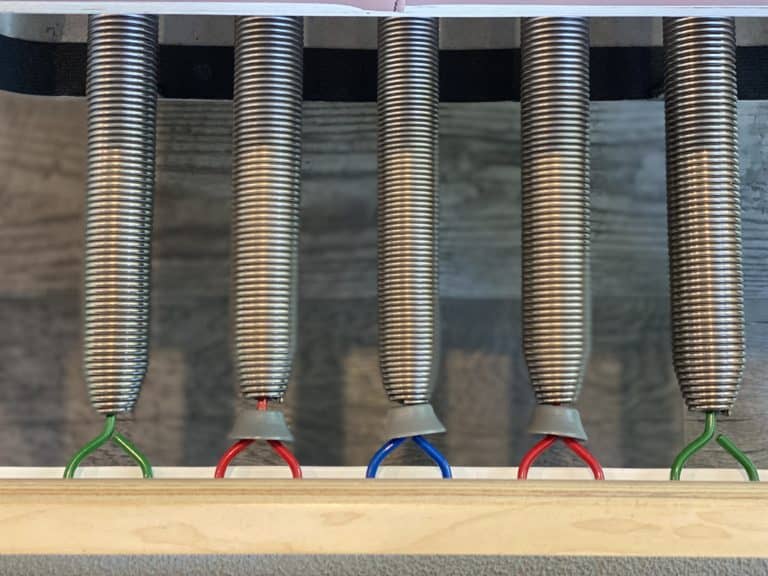
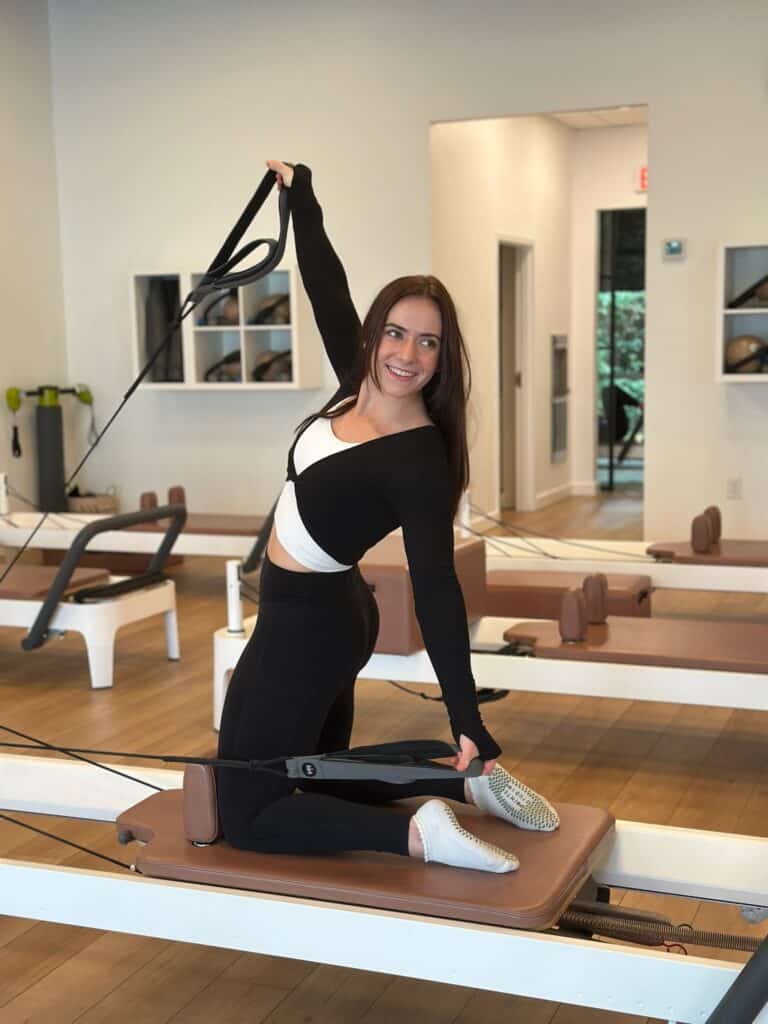
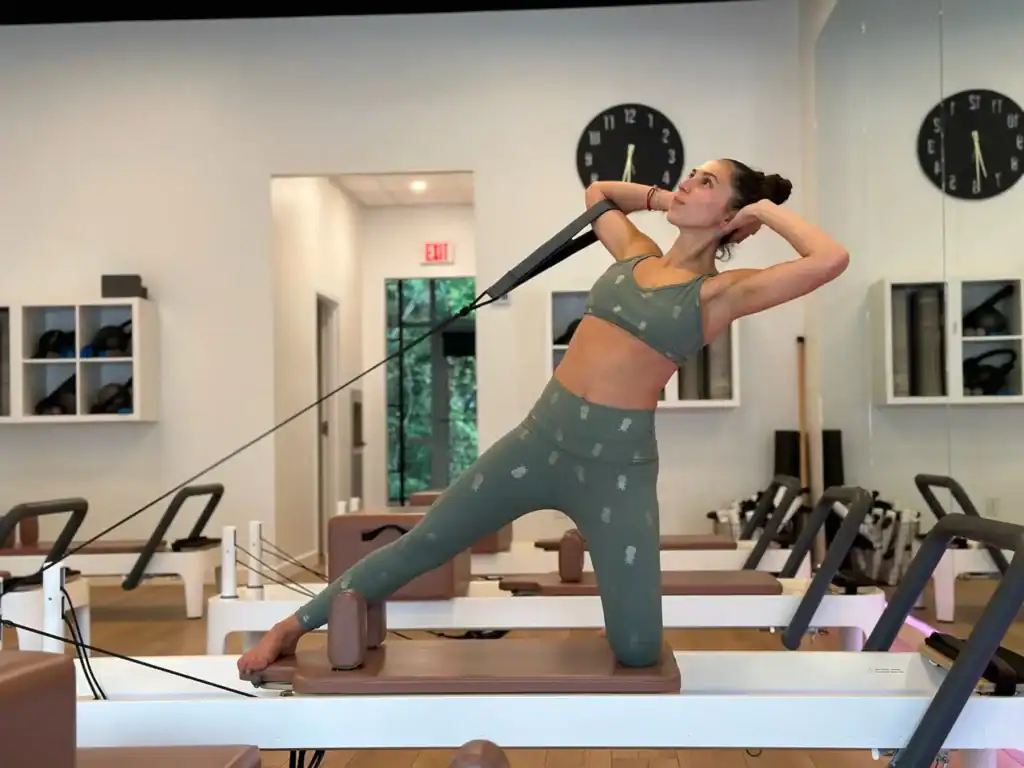
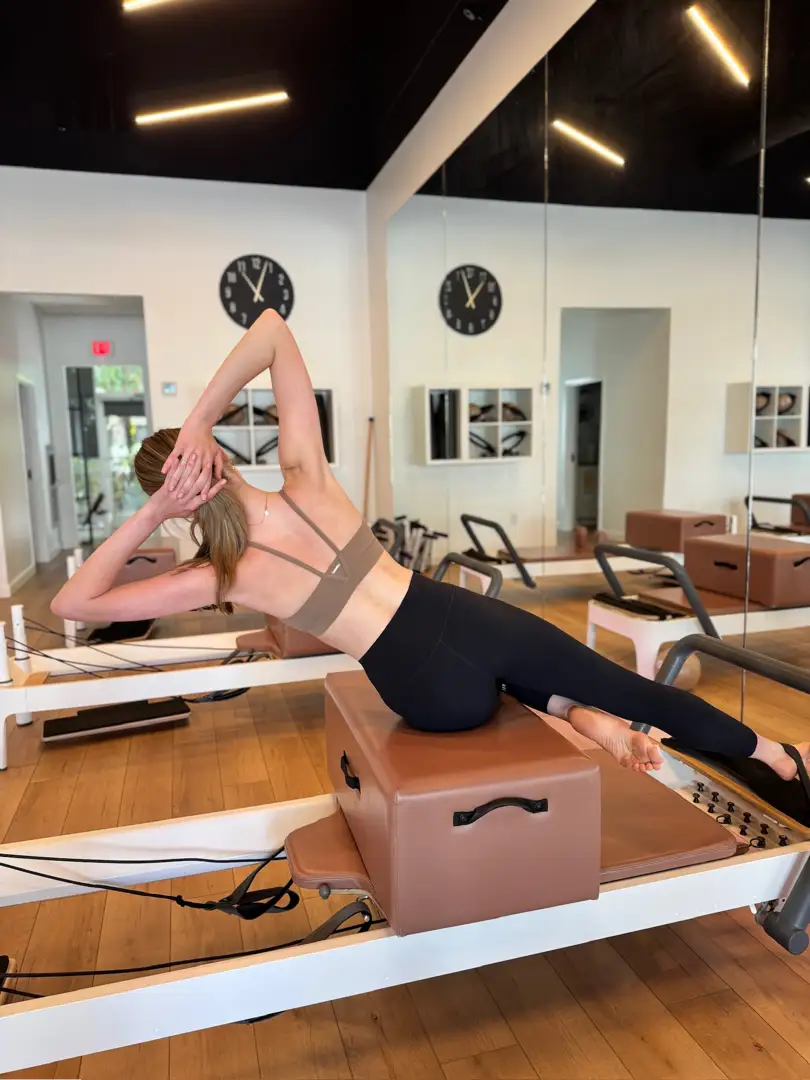
- Reformer Training: While mat Pilates is great, the reformer takes things to the next level. At Pilates of Charleston, we use Balanced Body Allegro 2 Reformers. The springs provide adjustable resistance that can either assist you (making hard moves possible) or challenge you (making simple moves intense). The instability of the reformer carriage forces your core to work 2x harder to maintain balance.
Beyond aesthetics, Pilates is a powerhouse for health. Research on Pilates for lower back pain relief shows that by firing up the “powerhouse,” you take the pressure off your lumbar spine, improving posture and reducing chronic pain.
How Long to See Results from Pilates for Abs and Waistline?
Joseph Pilates said: “In 10 sessions you’ll feel the difference, in 20 sessions you’ll see the difference, and in 30 sessions you’ll have a whole new body.”
In our experience, here is a realistic timeline:
- 3 Weeks (The Activation Phase): You’ll notice you’re standing taller. You’ll “feel” your abs more during everyday tasks like lifting groceries.
- 6-8 Weeks (The Strength Phase): You’ll be able to hold planks longer and perform advanced moves like the Teaser with less wobbling.
- 12+ Weeks (The Transformation Phase): With consistent practice (2-3 times per week) and a balanced diet, this is where visible changes in muscle tone and waistline definition typically appear.
Frequently Asked Questions
Can Pilates replace traditional ab workouts?
Yes and no. Pilates is superior for deep core stability, posture, and “cinching” the waist. However, if your goal is significant muscle “bulk” (like a bodybuilder), you might still want to include weighted core exercises. For most people seeking a lean, toned, and strong midsection, Pilates is more than enough to replace standard crunches.
Is Pilates safe for core strengthening during pregnancy?
Absolutely, but with modifications. After the first trimester, we generally avoid lying flat on the back for long periods. We focus on standing exercises, side-lying work, and “all-fours” (quadruped) positions to keep the core strong without straining the abdominal wall. Always consult your doctor before starting a new routine.
What equipment do I need for a Pilates waistline routine?
For home workouts, all you really need is a comfortable mat. As you progress, you can add “props” like a Pilates ring (Magic Circle), a small squishy ball, or light hand weights to increase the challenge. Of course, for the full experience, nothing beats a session on a Reformer.
Conclusion
Building a strong core and a defined waistline is a journey of precision, not speed. By focusing on the deep muscles of the Powerhouse, you aren’t just working toward a “flat stomach”—you are investing in better posture, a healthier back, and more powerful movement in everything you do.
At Pilates of Charleston, we pride ourselves on being the premier boutique studio in Mount Pleasant, SC. Voted “Best of” by our clients in 2023 and 2024, we offer an inviting environment where you can master the Balanced Body Allegro 2 Reformers under expert guidance. Whether you are a total beginner or an advanced practitioner, our all-levels instruction is designed to help you reach your goals.
Ready to start your core transformation? Check out More info about Pilates services and rates and join us in the studio to feel the Pilates difference for yourself!