Group Pilates, at most studios, means twenty machines in rows and an instructor on a microphone. At Pilates of Charleston in Mount Pleasant, it means eight reformers, eight people, and a teacher who knows every name in the room. The cap is not a slogan — it is the number of machines on the floor, and it is published alongside the studio’s rates. Here is what those 45 minutes actually look like, from the front door to the last stretch.
What group Pilates looks like with only eight reformers
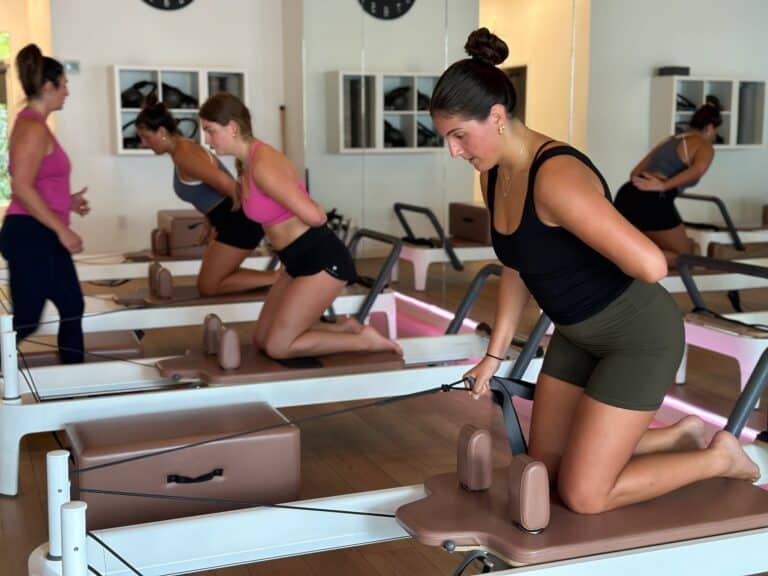
A reformer is a low carriage that slides on rails inside a wooden frame, with springs underneath and straps at both ends. It can look a bit like a medieval contraption the first time you meet one. Most people think so, and saying it out loud is a fine way to start a conversation with your instructor.
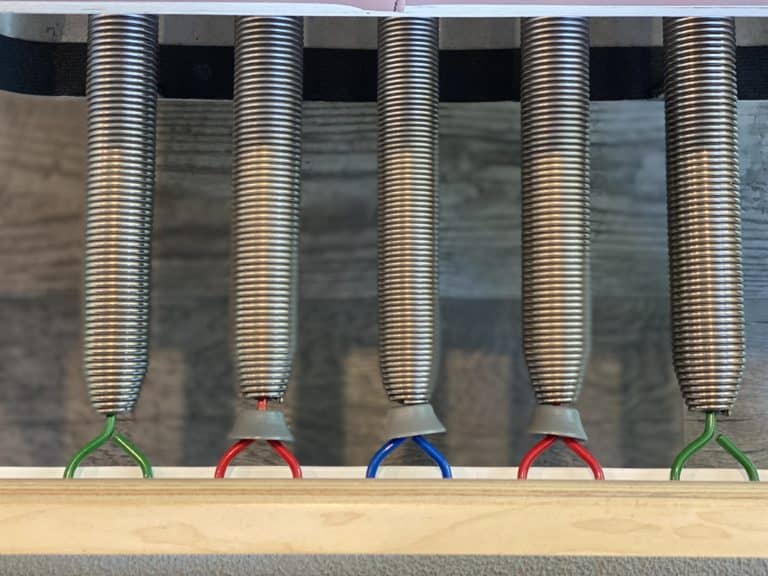
The springs do two jobs at once. They add resistance when you press away from the footbar — the padded bar at the end of the carriage — and they carry part of your weight when a movement would otherwise be out of reach. That second job is why one class can hold someone in their first week and someone in their tenth year without either of them being bored or buried. If you want the long version of how the machine works, the complete guide to reformer Pilates in Charleston walks through the equipment, the formats and what getting started involves.
Eight carriages also means something physical and simple: the instructor can reach any person in the room in about three steps.
The first ten minutes
Come ten minutes early for your first class. The studio is at 778 S. Shelmore Blvd in Mount Pleasant, next door to Langdon’s and Wood & Grain. If you have never driven to that block, check where to find the studio on S. Shelmore Blvd before you leave home. Second State coffee is next door, and it is the right place to wait out any time you have to spare.
Inside, you give your name and say what hurts. A shoulder that clicks, a wrist that does not like weight, a lower back that flares up in the afternoon — every client is asked to tell the instructor before class starts, and a spring setting, a strap position or a whole exercise can be changed for you on the spot. If you are working through something significant, the better starting point is a private reformer session, where the session is built entirely around what your body is doing now.
Then you pick a reformer and set your own springs and footbar height, with the instructor showing you how before anything begins. New faces get the tour: what the straps do, where to put your feet, which direction the carriage travels. Nobody is expected to already know.
What eight people changes about a group Pilates class
In a big room, an instructor teaches to the middle. The cues go out to everyone, the pace suits the average, and whoever is struggling at the back is mostly on their own. In a room of eight, that math falls apart in your favor. The instructor can put a hand on your ribs to show you where the breath goes, have you change your springs mid-exercise because you are stronger on the left than the right, and hand you a different version of a movement without stopping the class.
It changes the sound of the room too. Eight people can talk to each other, and they tend to learn each other’s names. Pilates of Charleston has been open in Mount Pleasant since 2011 under the same owner, who has taught Pilates for more than twenty years and films for Dynamic Pilates TV. If it matters to you who is at the front of the room, you can meet the instructors who teach these classes before you book. Charleston City Paper readers voted the studio Best Pilates Studio in 2023 and 2024, and it is nominated again in 2026.
Who a group class fits, and who starts somewhere else
The honest answer is that most people fit. The room is meant to be inviting rather than intimidating, and no class assumes you have ever touched a reformer. If the idea still makes you nervous, a beginner’s guide to Pilates in Mount Pleasant covers the first-timer questions most people arrive with. Clients come from Mount Pleasant, Daniel Island, Isle of Palms, Sullivan’s Island and downtown Charleston.
The exception is injury. If you are rehabbing a surgery or managing something that changes what your body can safely do, the studio steers you to a private session first — not to keep you out of the group room, but to get you into it with a plan. Tell the instructor either way; that disclosure is asked of every client, every time.
Class packs, bookings and the one policy that does not bend
There is no membership, no contract and no auto-renew: a drop-in class is $40, a pack of four is $150, and a pack of eight is $260. Rates are published on the site next to the eight-person cap, so you can see what you are buying before you call anyone. Spots are limited by the number of machines, which is the whole point, and also the reason booking ahead matters more here than at a studio with thirty reformers.
The cancellation policy is firm, and it has no exceptions — not for weather, not for traffic. With eight spots in the room, a late cancellation is a seat nobody else could take, so put the class in your calendar the way you would a dentist appointment.
Groups of friends can take the room together. Charleston bachelorette parties are a published part of what the studio does, and the same eight-reformer setup that makes a regular class personal makes a group booking easy to teach: everyone moves at once, nobody is lost at the back, and coffee next door is already part of the morning.
Booking your first class in Mount Pleasant
Pick a time that you can keep, book it, and arrive ten minutes early. Tell the instructor your name and anything that aches. Expect to be corrected by name at least twice, and expect your legs to tell you about it the next morning. If you still have questions about levels, timing or what to bring, the studio’s frequently asked questions answer most of them, and the 46 five-star reviews on its Google Business Profile describe the class from the other side of the room.
Eight reformers. Eight people. That is the whole offer, and it is the reason the group class at Pilates of Charleston feels less like a fitness class and more like being taught.
Frequently asked questions
How many people are in a group Pilates class at Pilates of Charleston?
Eight, and never more. The studio has eight reformers on the floor, so the class size is set by the equipment rather than by a sales target, and the cap is published next to the studio’s rates. It is the reason an instructor can correct your form by name instead of calling cues over a crowd.
Do I need experience before taking a group reformer class?
No. Classes are taught on the assumption that someone in the room is new, and the instructor shows you how to set your own springs and footbar before anything starts. A reformer looks unfamiliar the first time, and the opening minutes are spent showing you what the straps and the carriage do. Say it is your first class when you give your name at the door.
What should I wear to a reformer class?
Fitted athletic clothes work best, because the instructor needs to see how your spine and hips are moving in order to correct you. Skip loose tops that fall over your head when your hips are higher than your shoulders, and leave rings and long necklaces at home. Many reformer studios ask clients to wear grip socks, so check with the studio before your first visit.
Should I book a private session instead of a group class?
If you are recovering from surgery or managing an injury or condition that changes what your body can safely do, start with a private session. The instructor can build that session entirely around your situation and tell you when the group room is a good fit. Everyone else is still asked to disclose injuries before class, so springs, straps or a single exercise can be adjusted for you.
Can a group of friends book a class together?
Yes. Group bookings are a published part of what Pilates of Charleston does, and bachelorette weekends are one of the most common reasons people reserve the room. Eight reformers means eight guests moving at the same time with one instructor who can actually see all of them. Contact the studio for available times.
Is a reformer class a real workout if I already run or lift?
Yes, and the springs are the reason. Resistance can be set heavy enough to challenge a strong athlete and light enough to support a movement someone else cannot reach yet, which is how one class holds both. Reformer work also tends to find the small stabilizing muscles that running and lifting skip, so expect the first session to be humbling in an unexpected place.