Does Pilates Really Make You More Flexible? Here’s the Truth
Does pilates increase flexibility — and the short answer is: yes, significantly. Research backs this up clearly.
Quick answer:
- Pilates improves flexibility through controlled, active movement that lengthens muscles while building strength
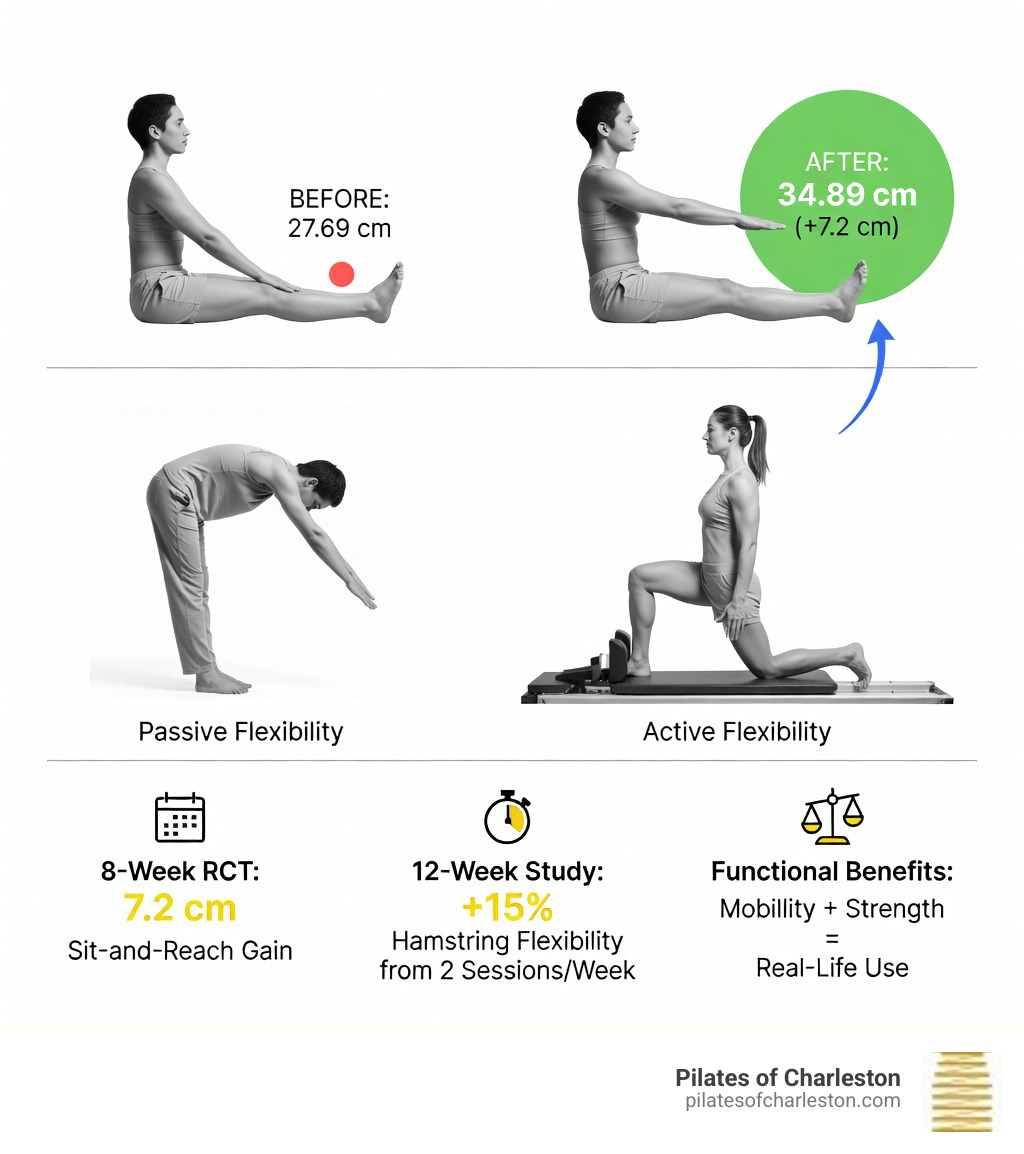
- A published randomized controlled trial found Pilates participants improved their sit-and-reach score by over 7 cm in just 8 weeks (from 27.69 cm to 34.89 cm), while the control group showed virtually no change
- A separate 12-week study found significant hamstring flexibility gains in active adults doing just two 60-minute sessions per week
- Pilates also builds functional flexibility — meaning you can actually use that range of motion in real life, not just in a stretch
But here’s what most people don’t know: Pilates doesn’t build flexibility the way traditional stretching does. It builds something better.
If you’ve been running, hitting the gym, or doing yoga around the Charleston area and still feel tight, stiff, or limited in your movement — you’re not alone. Many active people have flexibility without control, or strength without range. Pilates addresses both at the same time.
Whether you’re a busy professional in Mount Pleasant looking to move better, or someone dealing with nagging tightness from years of desk work, understanding how Pilates improves flexibility can change the way you think about your whole fitness routine.
Flexibility vs. Mobility: Why Does Pilates Increase Flexibility Differently?

When we talk about “loosening up,” we often use the terms flexibility and mobility interchangeably. However, in What is Pilates?, these two concepts are distinct and equally vital for a healthy, pain-free Charleston lifestyle.
Flexibility is the ability of a muscle to passively stretch and lengthen. Think of someone pulling your leg toward your chest while you lie on the floor. It’s about how much “give” your tissues have.
Mobility, on the other hand, is the ability of a joint to move through its full range of motion with active control and strength. This is the “usable” range you need when you’re reaching for a high shelf in your kitchen or swinging a golf club at a course in Mount Pleasant.
| Feature | Passive Flexibility | Functional Mobility (Pilates Focus) |
|---|---|---|
| Effort | Low/Passive (Gravity or a band pulls you) | High/Active (Your muscles drive the move) |
| Control | Minimal control at the end-range | Full control and stability throughout |
| Benefit | Temporary muscle lengthening | Long-term joint health and injury prevention |
| Nervous System | Can trigger “protective” tightening | Teaches the brain that the range is safe |
Pilates is unique because it emphasizes eccentric contractions. This means your muscles are strengthening while they are lengthening. Imagine a strong rubber band; flexibility is how far it stretches, but Pilates ensures that rubber band remains strong and resilient even at its longest point. By regulating the nervous system through mindful, controlled movement, we teach your body that it is safe to access these deeper ranges of motion.
The Science: How Does Pilates Increase Flexibility and Stability?
We aren’t just making claims based on how good a Reformer session feels; the data is in. According to Scientific research on lumbo-pelvic stability and flexibility, Pilates is one of the most effective ways to see measurable physical changes.
In a landmark study, a Pilates training group practiced 45-minute mat sessions twice weekly. After just 8 weeks, their sit-and-reach scores jumped from a baseline of 27.69 cm to 34.89 cm—a 7.2 cm gain. Meanwhile, the control group (those who didn’t do Pilates) saw no significant change.
Furthermore, 85% of the Pilates group passed a lumbo-pelvic stability test by the end of the study, compared to 0% at the start. This proves that as you get more flexible, you also get more stable.
Why does this happen?
The secret lies in the physiological response of your tissues:
- Golgi Tendon Organ (GTO) Inhibition: Pilates uses controlled tension to “reset” the GTO, which is your body’s internal sensor that tells muscles to tighten up to prevent injury.
- Viscoelastic Properties and Creep: By moving slowly and holding controlled positions, we take advantage of the “creep” phenomenon—where tissues gradually lengthen under constant, low-level stress.
- Type I Muscle Fiber Adaptation: The deep stabilizers of your core are made of Type I fibers, which respond perfectly to the 45-minute low-to-moderate intensity sessions we offer.
Research on muscle endurance and hamstring reach also suggests that even active adults can see significant gains in upper-body endurance and hamstring flexibility in 12 weeks, even with just two hours of practice per week.
Pilates vs. Traditional Stretching and Other Flexibility Methods
Many of our clients come to us after years of trying traditional static stretching (holding a pose for 30 seconds) without seeing results. The problem with static stretching is that it is often passive. If you have “brakes” on your movement because your brain doesn’t think you’re strong enough to handle a certain range, no amount of pulling on your hamstrings will make them let go.
In our Stretch Class, we move away from static holds and toward dynamic, strength-based lengthening.
- Injury Prevention: Traditional stretching can sometimes lead to over-stretching or “hypermobility” without support. Pilates builds the “powerhouse” (your core) to support your joints as they open up.
- Pelvic Floor Engagement: Every stretch in Pilates begins with the core. This internal support protects the spine during deep reaches.
- Foot Alignment: We often find that tightness in the hips starts with the feet. By focusing on Foot Alignment, we ensure that your flexibility gains are balanced from the ground up.
5 Essential Exercises to Boost Your Range of Motion
If you’re wondering exactly how these principles look in action, here are five moves that demonstrate how does pilates increase flexibility through functional movement.
How the Mermaid Exercise Does Pilates Increase Flexibility
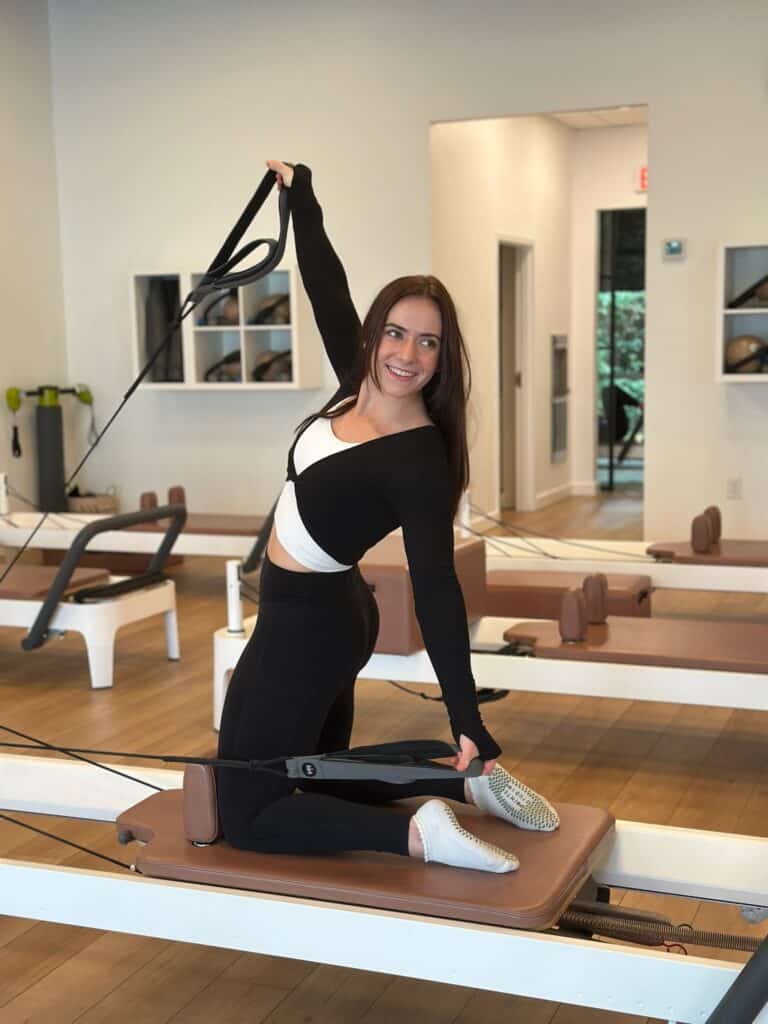
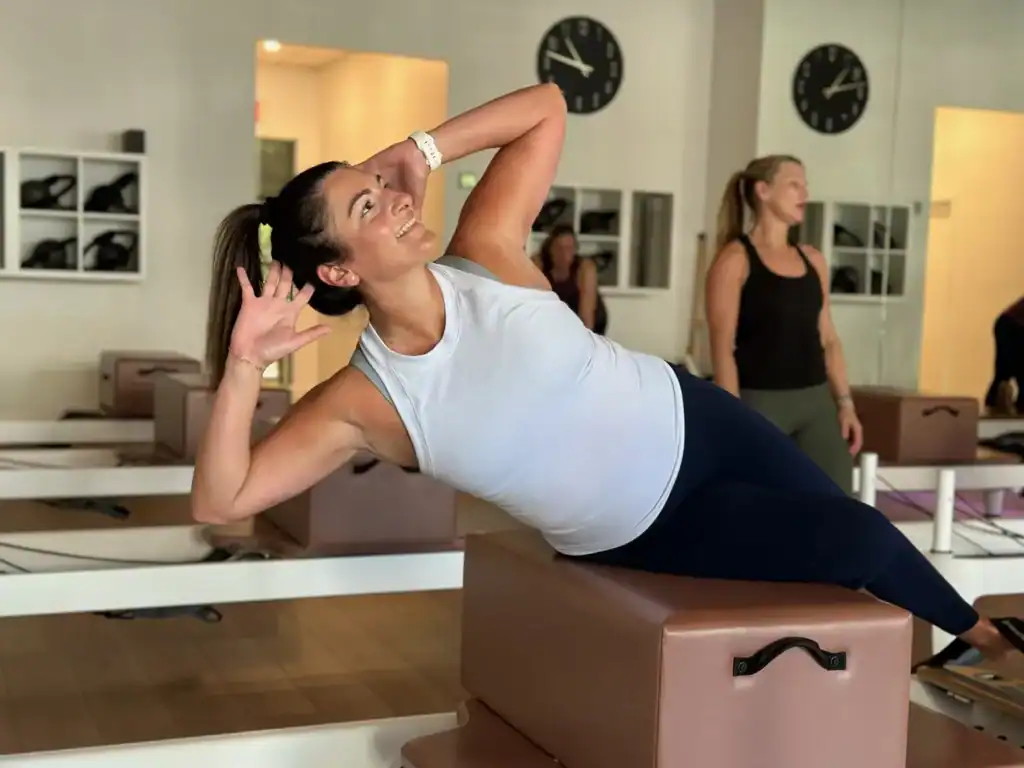
The Mermaid is a favorite at our Mount Pleasant studio for opening the side body.
- The Move: Sitting on the Reformer or mat, you reach one arm overhead and bend laterally to the side.
- The Benefit: This provides lateral flexion for the spine, lengthening the obliques and expanding the intercostal muscles between your ribs. It’s a fantastic way to achieve spinal decompression and correct the “slumped” posture many of us develop at our desks.
Using the Saw to Improve Functional Reach
The Saw is the ultimate multi-tasker for flexibility.
- The Move: Sitting with legs extended, you rotate your spine and reach toward the opposite foot.
- The Benefit: It targets hamstring flexibility while simultaneously working on spinal rotation. Because you have to stay “lifted” through your core, it’s an active stretch that builds scapular stability and a core-driven reach.
Other Key Moves: Roll Up, Leg Circles, and Double Leg Kick
- The Roll Up: This move challenges abdominal endurance while providing a massive stretch for the entire posterior chain (the back of your body). It’s far more effective for hamstring reach than a simple toe-touch.
- Leg Circles: Performed lying on your back, these circles lubricate the hip socket. They build “dissociation,” meaning you learn to move your leg freely without your pelvis rocking back and forth.
- Double Leg Kick: This prone exercise opens the chest and shoulders while strengthening the back. It’s the perfect antidote to “tech neck” and tight chest muscles.
To master these moves with precision, many clients start with a Pilates Training Session to ensure their form is perfect before jumping into group classes.
Getting Started: Your Journey to Better Movement in Charleston
How Long Does Pilates Take to Increase Flexibility?
Joseph Pilates said: “In 10 sessions you’ll feel the difference, in 20 sessions you’ll see the difference, and in 30 sessions you’ll have a whole new body.”
When it comes to flexibility, the 8-week mark is often the “sweet spot” where the nervous system and muscle tissues have fully adapted. However, most of our Mount Pleasant clients report feeling “taller” and “lighter” after their very first class. The Benefits of Pilates are cumulative; the more consistent you are, the more your body “remembers” its new, open range of motion.
Who Can Benefit from Flexibility Training?
The beauty of contemporary Pilates is that it is infinitely adaptable.
- Desk Workers: To reverse the “shortening” of the hip flexors and chest.
- Charleston Athletes: To improve the efficiency of movement in tennis, golf, or running.
- Seniors: To improve balance, coordination, and fall prevention.
- Post-Rehab Clients: To gently regain range of motion after an injury.
There are very few prerequisites for Pilates. Whether you can touch your toes or can barely reach your knees, our instructors provide personalized modifications to meet you where you are.
Frequently Asked Questions About Pilates and Flexibility
Is Pilates better than static stretching for tight hamstrings?
Yes, for most people. Static stretching can sometimes cause the muscle to “snap back” if it’s overdone. Pilates uses eccentric strengthening, which tells your nervous system that it’s safe to keep the new length because you have the strength to support it.
Can I start Pilates if I am currently very inflexible?
Absolutely! In fact, you are the perfect candidate. We hear “I’m too stiff for Pilates” all the time, but that’s like saying you’re too dirty to take a bath. We start with the basics and use the Reformer’s springs to assist you into ranges you might not be able to reach on your own.
Do I need to use a Reformer to see flexibility gains?
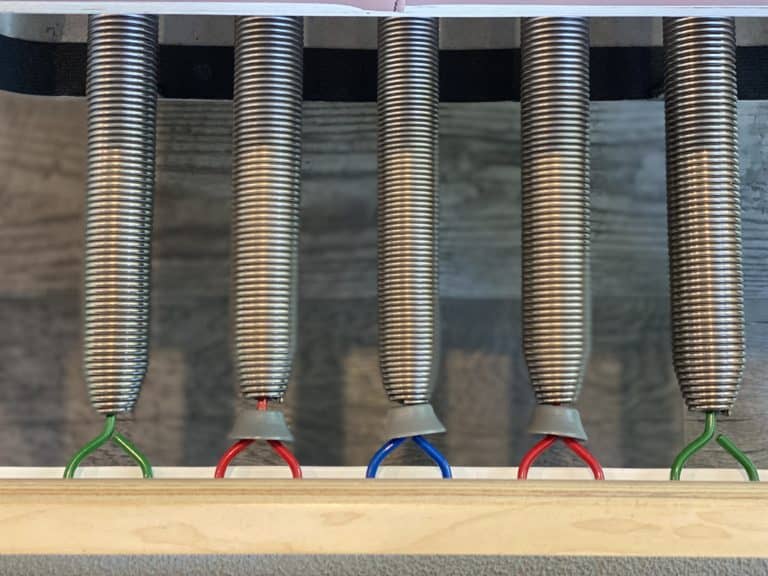
While mat Pilates is highly effective, the Balanced Body Allegro 2 Reformers we use at Pilates of Charleston provide a unique advantage. The springs and pulleys offer resistance that can either challenge you or act as a “helping hand,” allowing you to access deeper, more supported stretches than you could on a mat alone.
Conclusion: Experience the Pilates of Charleston Difference
If you’re ready to stop feeling stiff and start moving with ease, we invite you to join our energetic community. At our boutique studio in Mount Pleasant, we combine results-driven contemporary Pilates with a supportive atmosphere that makes every session feel personal.
Our expert instructors are passionate about helping you stand taller and move better. Whether you’re joining us from Sullivan’s Island, Daniel Island, or downtown Charleston, you’ll find a welcoming space to challenge your body and clear your mind.
Are you ready to see how 8 weeks of Pilates can transform your flexibility?
Book your first class at Pilates of Charleston today and feel the difference for yourself.
Call us at (843) 608-8660 or visit our studio in Mount Pleasant to start your journey toward a stronger, more flexible you!