So You Want to Get Pilates Certified — Here’s What You Need to Know
Getting Pilates certified is more achievable than most people think. Here’s the quick version:
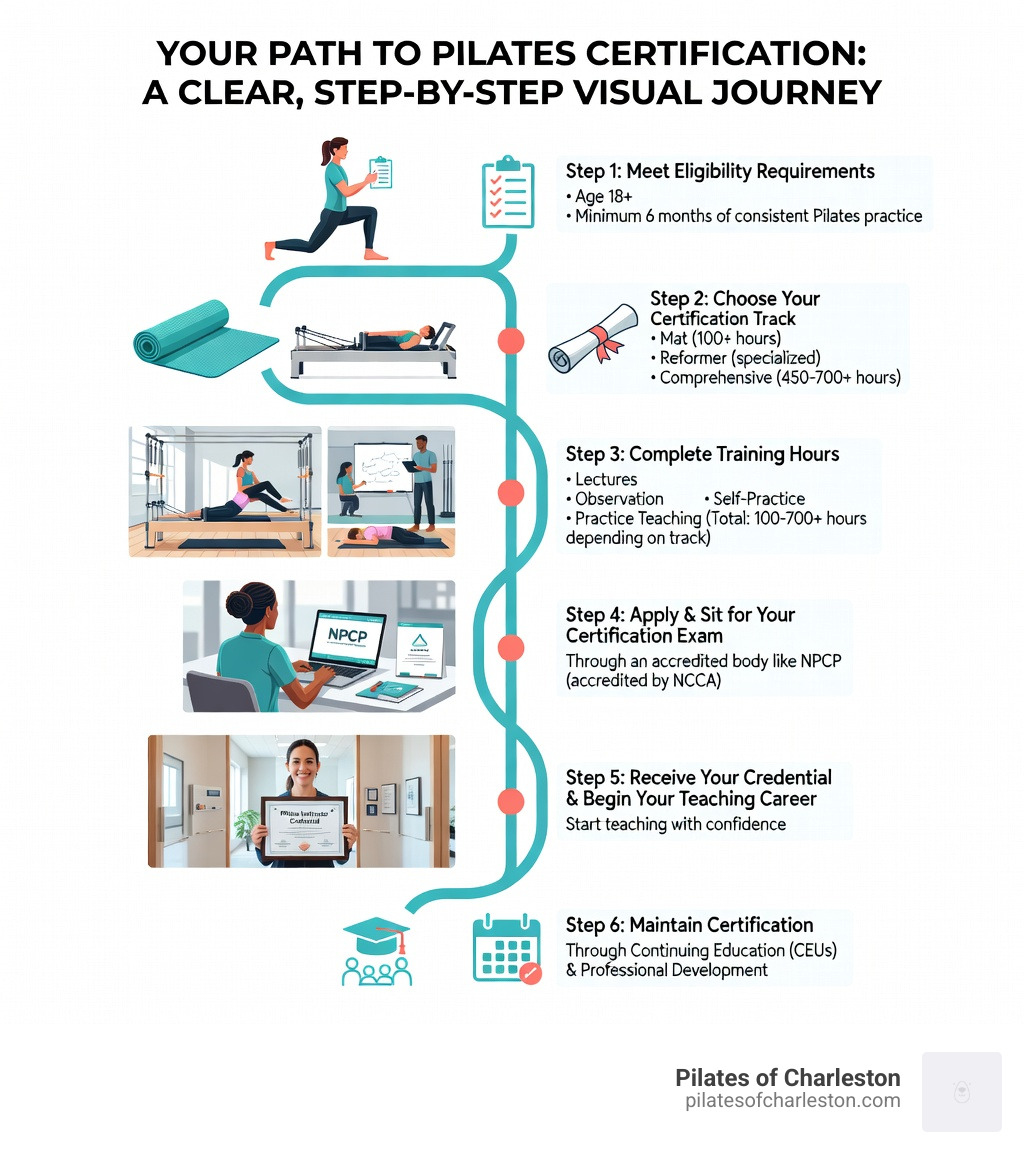
- Meet the basics — You must be at least 18 years old and have some Pilates practice experience.
- Choose your certification track — Mat only, Reformer, or a full Comprehensive program.
- Complete your training hours — Mat certification requires a minimum of 100 hours; comprehensive programs range from 450 to 700+ hours.
- Pass your exam — Through an accredited body like the National Pilates Certification Program (NPCP), which is accredited by the National Commission for Certifying Agencies (NCCA).
- Receive your credential — And start teaching with confidence.
Maybe you’ve been practicing Pilates for years and something shifted. You started noticing how it changed your posture, your strength, your stress levels — and you thought: I want to help other people feel this way.
That instinct is exactly where most great Pilates instructors begin.
But turning that passion into a professional credential can feel overwhelming. There are multiple certification bodies, different training formats, varying hour requirements, and a wide range of costs. It’s hard to know where to start.
This guide breaks it all down — clearly and simply — so you can find the right path for you.
Understanding the Path to Get Pilates Certified
When we talk about the journey to get pilates certified, we aren’t just talking about a piece of paper to hang on the wall. We are talking about a deep dive into movement science, safety protocols, and the art of teaching. The Pilates industry has evolved significantly since the days of Joseph Pilates, moving from a “watch and learn” apprenticeship model to a structured, science-backed educational framework.
Today, the gold standard for the industry is the Steps to becoming a Nationally Certified Pilates Teacher. This process ensures that instructors aren’t just doing the moves themselves but understand the “why” behind every leg circle and spinal articulation.
A high-quality certification program focuses on:
- Safety Protocols: Learning how to spot clients and manage equipment to prevent injury.
- Teaching Confidence: Developing the “instructor voice” and the ability to command a room.
- Functional Anatomy: Understanding how the body moves, including neuromuscular recruitment and joint mobility.
- Pedagogical Best Practices: Learning how to actually teach different learning styles, using a mix of verbal, visual, and tactile cues.
Why You Should Get Pilates Certified
Beyond the personal satisfaction of mastering the repertoire, there are massive career benefits to becoming a professional.
- Job-Ready Skills: You’ll graduate with the ability to create safe, effective workouts for everyone from professional athletes to those in rehab.
- Global Recognition: Many programs are trusted in over 135 countries, meaning your skills can travel with you.
- Client Trust: In a boutique fitness world, clients want to know their instructor has a deep understanding of what Pilates is and its benefits.
- Career Longevity: Pilates is a low-impact career. Unlike high-intensity modalities that can wear on an instructor’s body, Pilates focuses on mindful movement that supports your own health as you teach.
Eligibility and Prerequisites for Aspiring Teachers
Before you dive into the deep end, there are a few boxes we need to check. Most reputable programs require:
- Minimum Age: You must be at least 18 years old.
- Anatomy Foundations: Many schools require a prerequisite course like “Anatomy for Motion” (usually about 6 hours) before you can start Mat or Reformer training.
- Prior Experience: You can’t teach what you haven’t felt. Most programs suggest a minimum of 20-30 hours of personal practice before enrolling.
- Physical Stamina: Teaching involves being on your feet, demonstrating moves, and moving heavy Reformer carriages. You need to be in a physical place where you can handle the “lab” portions of the training.
Types of Pilates Certifications and Equipment
One of the first decisions you’ll make when you decide to get pilates certified is which “track” to take. Unlike some fitness certifications that are one-size-fits-all, Pilates is modular.
| Track | Focus | Typical Hours | Best For |
|---|---|---|---|
| Mat Certification | Floor-based exercises using body weight. | 100 – 160 hours | Beginners, yoga teachers, and home-based instructors. |
| Reformer Certification | Exercise on the Reformer machine. | 200 – 300 hours | Studio-based instructors; the most popular gym-based modality. |
| Comprehensive Certification | All apparatus (Cadillac, Chair, Barrels, etc.). | 450 – 700+ hours | Career professionals wanting to work in full-service studios. |
Choosing the Right Level to Get Pilates Certified
If you’re just starting out, Mat Certification is the foundation. It covers the 34 classical exercises established in Joseph Pilates’ book, Return to Life. You can review the Pilates Mat Eligibility Requirements to see exactly what the National Pilates Certification Program expects from candidates.
However, if your goal is to work in a boutique studio like ours, you’ll likely want to pursue a Comprehensive Track. This includes:
- The Reformer: The most famous piece of equipment, using springs and pulleys for resistance.
- The Cadillac (Trapeze Table): A large frame that allows for acrobatic and rehabilitative movements.
- The Wunda Chair: A compact piece of equipment that provides a challenging, balance-focused workout.
- Small Apparatus: This includes the Spine Corrector, Ladder Barrel, and Springboard.
Some students prefer Modular Training, where they take one piece of equipment at a time (e.g., Mat this year, Reformer next year). Others dive into a 600-hour comprehensive program to get it all done at once.
Online vs. In-Person Training Formats
The “online vs. in-person” debate is big in the Pilates world.
- Online/Hybrid Models: These are fantastic for flexible scheduling. Some programs offer 200+ videos and virtual Zoom Q&As. This is often more affordable and great for those in remote areas.
- In-Person Training: This is generally best for beginners. There is no substitute for “hands-on cueing” where a master trainer physically adjusts your alignment.
- The Middle Ground: Many modern programs use a hybrid approach—you watch anatomy lectures online but meet in person for the “labs” where you practice teaching on the actual equipment.
Requirements, Costs, and Time Commitments
Let’s talk numbers. When you decide to get pilates certified, you are making a financial and time investment in your future.
The Financial Breakdown:
- Mat Certification: Generally ranges from $1,000 to $1,600. For example, a high-quality Mat & Anatomy bundle might cost around $1,550 CAD.
- Reformer Certification: This is a bigger jump, often costing between $2,500 and $3,000.
- Comprehensive Programs: These are the most expensive, often ranging from $3,700 to $6,000+, depending on the school and materials.
- Hidden Costs: Don’t forget to budget for books ($300-$400), exam fees ($200-$300), and the cost of taking classes yourself to fulfill your “self-practice” hours.
The Time Commitment: Becoming an instructor isn’t a weekend workshop; it’s a marathon.
- Mat Only: ~100 to 160 hours.
- Reformer Only: ~200 to 270 hours.
- Comprehensive: 450 to 700 hours.
For many, a comprehensive track takes about a year to complete when balancing a full-time job. You can learn more about what the day-to-day looks like by browsing Pilates Instructor Jobs.
How to Prepare for Your Certification Exams
Once you’ve finished your modules, the real work begins: the “apprentice” hours. To sit for the exam, you must log:
- Observation Hours: Watching experienced instructors teach (without participating).
- Self-Practice Hours: Doing the workouts yourself to master the “feel” of the exercises.
- Practice Teaching: Teaching friends, family, or fellow students for free or at a reduced rate.
We recommend you Review the Exam Content Outline early in your process. This helps you focus your study on the specific neuromuscular principles and contraindications that the NPCP exam will cover.
Pro-Tip: Focus on your “Cueing Formulas.” A good instructor doesn’t just say “move your leg.” They use a formula: Part of the body + Direction + Goal. For example: “Reach your heels toward the mirror to find length in your hamstrings.”
Maintaining Your Credentials and Continuing Education
The learning doesn’t stop once you get your diploma. To keep your “Nationally Certified Pilates Teacher” status, you must earn Continuing Education Credits (CECs).
- Specialist Certificates: You might take workshops on Pilates for Pre-natal clients, Osteoporosis, or Athletic Conditioning.
- Bridge Programs: If you are already certified through one school but want to join another (for example, moving from a Mat-only school to a Comprehensive school), many institutions offer “Bridge” options so you don’t have to start from zero.
Frequently Asked Questions about Pilates Certification
How long does it take to get Pilates certified?
For a Mat certification, you can often finish in 3 to 4 months. For a full Comprehensive certification, expect it to take 9 to 18 months. This includes the time spent in the classroom plus the hundreds of hours required for practice teaching and observation.
What is the difference between Classical and Modern Pilates training?
Classical Pilates follows the exact order and exercises Joseph Pilates created, often using specific equipment designs. Modern (or Contemporary) Pilates integrates current exercise science, physical therapy principles, and biomechanics, often modifying exercises to fit the individual’s needs rather than forcing the body into a specific shape.
Is the NPCP exam required to teach at most studios?
While not every single studio requires the national exam, it is becoming the industry standard. Having that NCCA-accredited credential proves you have met a rigorous, third-party standard of safety and knowledge. It makes you significantly more hirable and allows you to teach at top-tier studios worldwide.
Conclusion
Deciding to get pilates certified is the first step toward a career that is as rewarding for you as it is for your clients. It’s about more than just fitness; it’s about building a community and helping people move through the world with less pain and more confidence.
At Pilates of Charleston, we pride ourselves on having a team that is not only highly trained but also deeply passionate about the “why” behind the movement. If you’ve finished your training or are looking for a place to start your journey in a supportive, boutique environment, we would love to meet you.
Join our team of expert instructors and see where your Pilates roadmap can take you!