Why Your Core Needs More Than Just Crunches
Pilates for core strength beginners is one of the most effective ways to build foundational strength without high-impact movements or complicated equipment. Here’s what you need to know to get started:
Essential Elements for Beginners:
- What it is: A mind-body exercise focusing on precise, controlled movements that activate deep core muscles
- Equipment needed: Just a yoga mat or soft surface to start
- Time commitment: 2-3 sessions per week, 15-30 minutes each
- Key muscles targeted: Transverse abdominis (deepest ab muscle), obliques, pelvic floor, and lower back
- First exercises to try: The Hundred, Pelvic Curl, Toe Taps, Single-Leg Stretch, Modified Plank
- Results timeline: Noticeable improvements in posture and stability within 10 sessions; dramatic changes by 30 sessions
If you’ve spent years doing crunches without seeing real results, you’re not alone. Most core exercises target only the superficial muscles you can see. Pilates works differently.
Developed nearly 100 years ago by Joseph Pilates, this method strengthens your body “from the inside out,” as Peloton instructor Kristin McGee explains. Instead of endless repetitions, Pilates uses small, precise movements that force your deepest core muscles to engage for stability.
Research backs this up. Studies show that Pilates increases activation of the transverse abdominis muscle—the deepest abdominal muscle that wraps around your spine like a corset. This deep core training can even help alleviate chronic lower back pain.
The best part? You don’t need fancy equipment or a gym membership. Mat Pilates uses your body weight to build strength, making it perfect for busy professionals who need effective workouts at home.
Why Pilates for Core Strength Beginners is a Game Changer
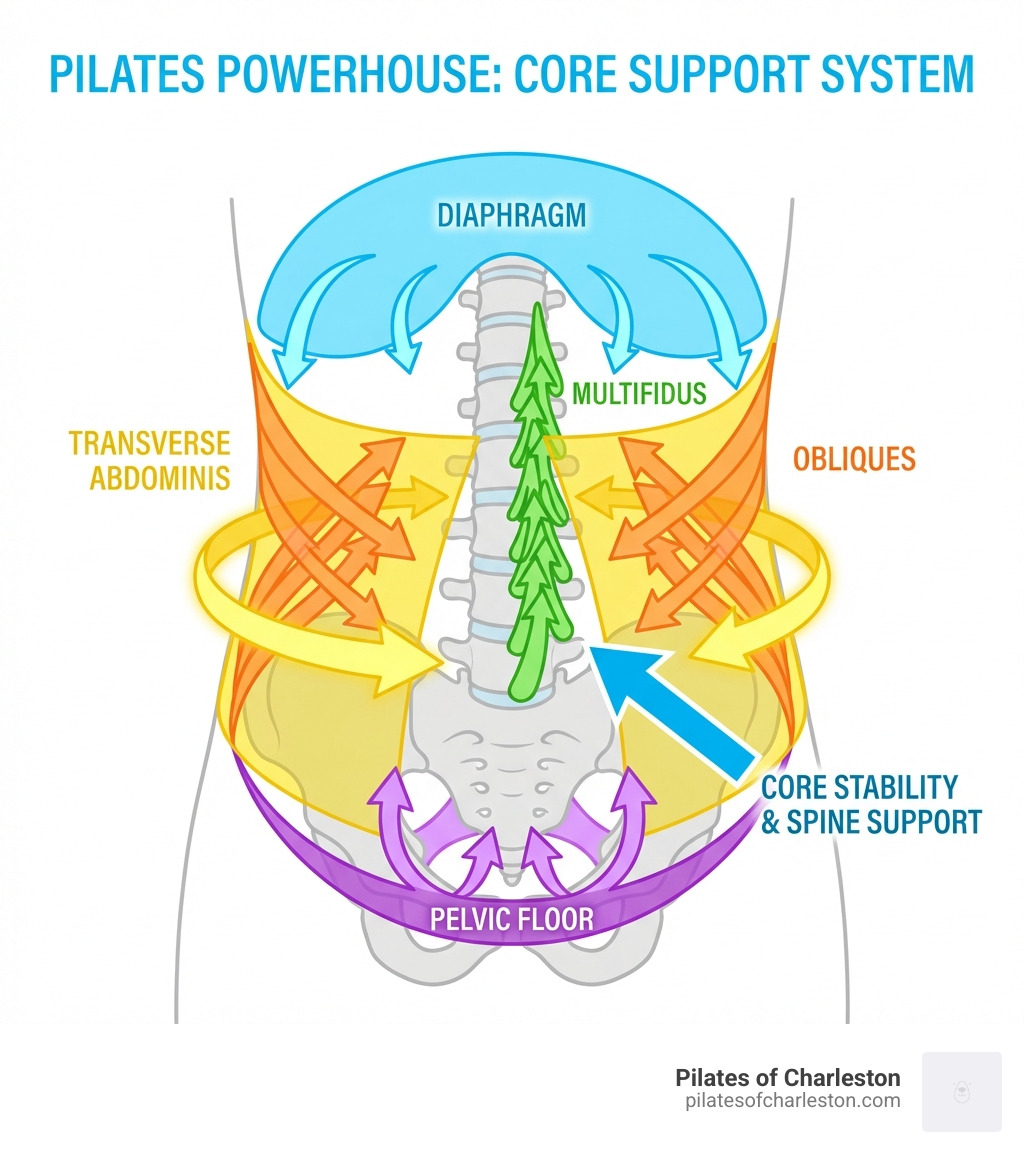
When we talk about “the core” in Pilates, we aren’t just talking about a six-pack. We are talking about the “Powerhouse”—the center of your body from the bottom of your ribs to the line across your hip joints. For those diving into pilates for core strength beginners, understanding this distinction is the first step toward a total body transformation.
Deep Muscle Activation
Standard crunches often rely on the rectus abdominis (the “six-pack” muscle). While that’s great for aesthetics, it doesn’t do much for spinal stability. Pilates targets the transverse abdominis (TVA). Research shows increased activation of the deep core during Pilates compared to traditional ab exercises. This muscle acts as your body’s internal corset, pulling everything in and supporting your internal organs.
Spinal Support and Pain Relief
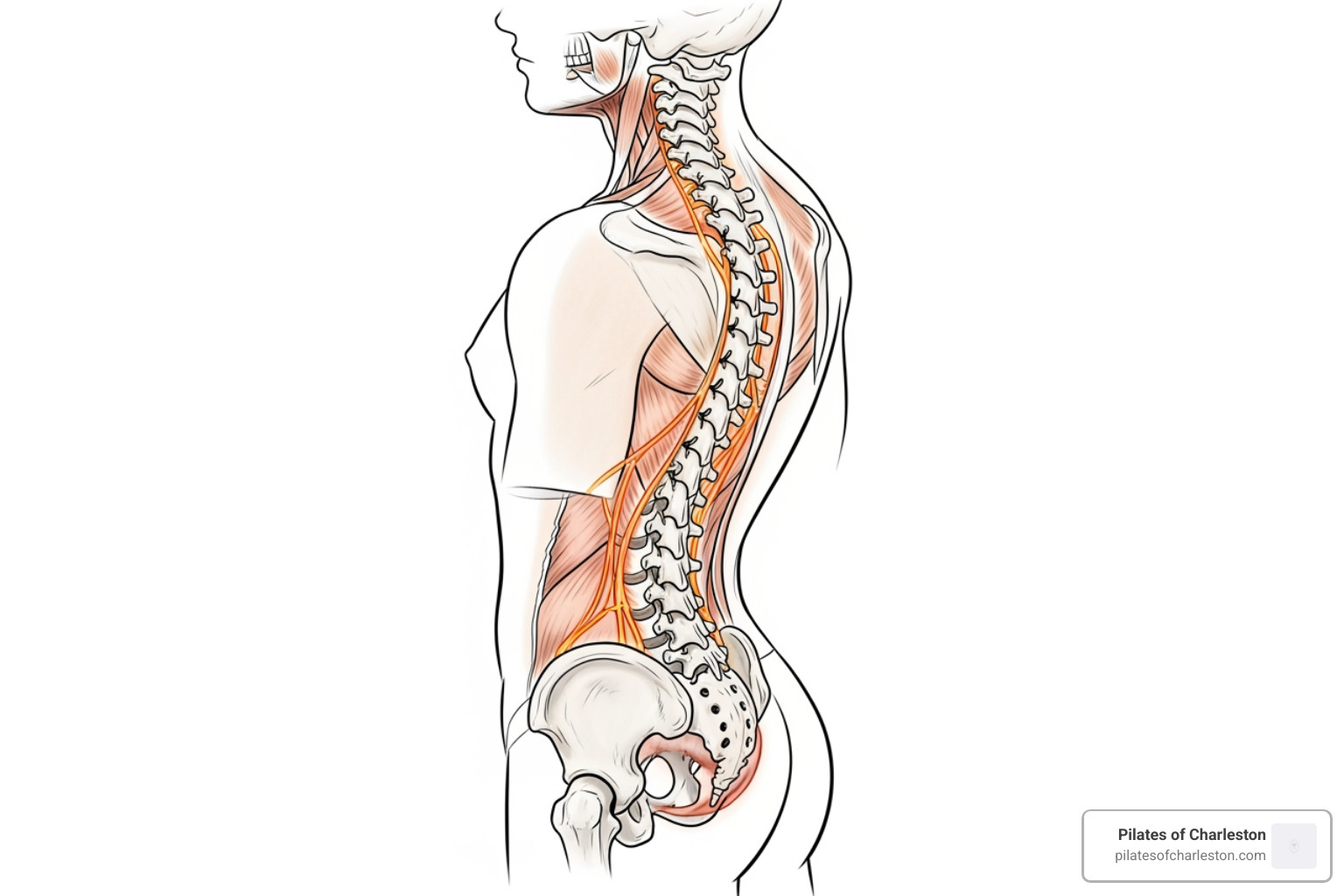
If you sit at a desk all day, your lower back likely pays the price. A weak core forces the muscles in your lower back to overcompensate, leading to that all-too-familiar ache. Because Pilates emphasizes spinal alignment and decompression, it is a powerful tool to alleviate chronic lower back pain. By strengthening the deep trunk muscles, you create a buffer that protects your spine from the stresses of daily life.
Posture and Stability
Have you ever noticed how Pilates instructors seem to “float” when they walk? That’s because a strong core improves posture and balance. When your center is stable, your limbs can move freely without tugging on your spine. This leads to better coordination and injury prevention in everything from running to carrying groceries.
The Mental Edge
Beyond the physical, Pilates has been shown to boost mood. The focus required to coordinate breath with movement acts as a form of moving meditation. You leave the mat feeling taller, stronger, and mentally refreshed.
Mastering the Fundamentals: How to Activate Your Deep Core
Before you start pumping your arms or lifting your legs, you have to find your “center.” Many beginners make the mistake of “popping” their abs out or holding their breath. To get the most out of pilates for core strength beginners, you must master these three pillars of engagement.
1. Finding a Neutral Pelvis
Lie on your back with your knees bent and feet flat. Your pelvis is “neutral” when your hip bones and pubic bone are on the same level plane. There should be a tiny, natural space between your lower back and the mat—just enough for a few blades of grass. If you press your back flat into the floor, that’s a “tucked” pelvis; if you arch it high, that’s “extended.” We want to work from neutral to build true stability.
2. The “Zipping Up” Sensation
To activate the TVA, imagine you are trying to zip up a pair of jeans that are one size too small. You aren’t sucking your stomach in so hard you can’t breathe; rather, you are gently drawing your belly button toward your spine and upward toward your ribs. This “scoop” creates a solid foundation for every movement.
3. Lateral Breathing
In many workouts, you breathe into your belly. In Pilates, we use lateral (ribcage) breathing. Since your core is “zipped up” and engaged, the air has nowhere to go but out to the sides of your ribs.
- The Umbrella Cue: Imagine your ribcage is an umbrella. As you inhale through your nose, the umbrella opens wide to the sides and back. As you exhale through pursed lips, the umbrella closes, and your ribs knit together.
4. Tabletop Position
You’ll hear this term constantly. Tabletop is when you lift your legs so your hips and knees are at 90-degree angles, with your shins parallel to the ceiling. The challenge? Keeping your back from arching as the weight of your legs pulls on your core.
7 Essential Exercises for Your First Pilates for Core Strength Beginners Routine
Ready to move? This routine focuses on control over speed. Perform these exercises on a mat or a firm, carpeted surface.
1. The Hundred
This is the classic Pilates warm-up. It builds heat and focuses the mind.
- How to do it: Lie on your back in tabletop. Curl your head, neck, and shoulders off the mat. Extend your arms long by your sides. Pump your arms up and down 6–8 inches.
- The Breath: Inhale for 5 pumps, exhale for 5 pumps. Repeat 10 times to reach 100.
- Modification: If your neck hurts, keep your head down or place a yoga block under it.
2. Pelvic Curl
This exercise focuses on spinal articulation—moving your spine one vertebra at a time.
- How to do it: Lie on your back, knees bent, feet flat. Exhale as you tilt your pelvis toward your nose and slowly peel your spine off the mat, starting from the tailbone, until you are in a bridge. Inhale at the top. Exhale as you roll back down, articulating each bone into the mat.
3. Single-Leg Stretch
This targets the obliques and lower abs while testing your stability.
- How to do it: Curl your head and shoulders up. Hug your right knee to your chest while extending your left leg to a 45-degree angle. Switch legs quickly but with control. Imagine your core is a heavy anchor keeping your torso perfectly still while your legs move.
4. Toe Taps
Don’t let the simplicity fool you; this is the ultimate test for the deep TVA.
- How to do it: Start in tabletop. Maintaining the 90-degree bend in your knee, slowly lower one foot toward the floor. Only go as low as you can without your lower back arching. Exhale to pull the leg back to tabletop using your abs.
5. Bird Dog (Swimming Preparation)
This move focuses on the back of the core and balance.
- How to do it: Start on all fours. Extend your right arm forward and your left leg back. Keep your hips level—imagine balancing a cup of tea on your lower back. Hold for 3 counts, then switch.
6. Rolling Like a Ball
This “playful” move massages the spine and requires deep ab scooping to stay balanced.
- How to do it: Sit with your knees tucked to your chest and feet lifted. Round your spine into a “C” curve. Roll back to your shoulder blades (never your neck!) and use your abs to pull yourself back up to a balance.
7. Modified Plank
Planks are the gold standard for core endurance.
- How to do it: Start on your forearms and knees. Ensure your body forms a straight line from your head to your knees. Draw your navel up and away from the floor. Hold for 30 seconds, focusing on that “umbrella” breathing.
For those looking to transition from the mat to more specialized equipment, you can find more info about mat and reformer services to see how these fundamentals translate to the studio.
Maximizing Results: Frequency, Equipment, and Form
To see the best results from pilates for core strength beginners, consistency is your best friend. You don’t need to spend hours on the mat; focused, high-quality sessions are much more effective than mindless repetitions.
Mat vs. Reformer: What’s the Difference?
While this guide focuses on mat work, many beginners find the Reformer (a specialized machine with springs and pulleys) helps them “feel” their core faster.
| Feature | Mat Pilates | Reformer Pilates |
|---|---|---|
| Resistance | Body weight & gravity | Springs & pulleys |
| Accessibility | Can do anywhere | Requires studio/machine |
| Focus | Internal control | Guided alignment |
| Challenge | Harder to “cheat” | Provides feedback via tension |
Practice Frequency
We recommend 2-3 sessions per week. This allows your muscles to recover while keeping the mind-body connection fresh. As Joseph Pilates said, “In 10 sessions you’ll feel the difference, in 20 sessions you’ll see the difference, and in 30 sessions you’ll have a whole new body.”
Equipment Essentials
You don’t need much to start at home:
- Yoga Mat: A slightly thicker mat is better for Pilates to cushion the spine during rolling exercises.
- Soft Surface: If you don’t have a mat, a firm carpet or a folded towel works in a pinch.
- Yoga Blocks: Great for supporting the head or sitting on to help with tight hip flexors.
Common Mistakes to Avoid
- Rushing: Pilates is about control. Ten slow, perfect reps are better than 50 fast, sloppy ones.
- Neck Strain: If your neck hurts during “head up” exercises, it usually means your abs aren’t doing the heavy lifting yet. Keep your head down until your core gets stronger.
- Holding Your Breath: If you stop breathing, your muscles stop working efficiently. Use the exhale to help you with the hardest part of the move.
If you find yourself struggling with form at home, it might be time to schedule a private session to get personalized cues that ensure you’re hitting the right muscles.
Frequently Asked Questions about Pilates for Core Strength Beginners
How long does it take to see results from Pilates for core strength beginners?
Most people feel a difference in their posture and “core awareness” after just one or two sessions. You’ll start to stand taller and feel more supported. Visible muscle tone and significant changes in chronic pain usually appear around the 10-session mark. By 30 sessions, if practiced 2-3 times a week, the transformation is often dramatic.
What equipment do I need to start Pilates at home?
The beauty of mat Pilates is its simplicity. You only need a mat and comfortable clothing that allows you to move freely. As you progress, you might add a Pilates ring (magic circle), resistance bands, or small weights, but they aren’t necessary for building a rock-solid foundation.
Can Pilates help with existing lower back pain?
Yes! In fact, Pilates was originally used for rehabilitation. By strengthening the deep trunk muscles and teaching the spine to move with “articulation,” Pilates decompresses the vertebrae. However, if you have a specific injury like a herniated disc, it’s always best to schedule a group class or private session with a certified instructor who can provide modifications.
Start Your Journey to a Stronger Center
Building a strong core isn’t just about looking good in a swimsuit—it’s about moving through life with ease, confidence, and zero pain. Whether you are a total fitness newbie or an athlete looking to level up, pilates for core strength beginners provides the blueprint for a body that works for you, not against you.
At Pilates of Charleston, we specialize in helping you find that deep connection. As the premier boutique studio in Mount Pleasant, SC—voted best by our clients in 2023 and 2024—we offer an inviting environment for all levels. Our studio features state-of-the-art Balanced Body Allegro 2 Reformers and a team of expert instructors dedicated to your progress.
Ready to trade those crunches for a stronger, leaner center? Visit our studio and let us help you build a core that supports you every single day.